

Table of Contents
- Why Full Grain Leather Sofas Outlast Everything Else
- Full Grain vs Top Grain Leather Furniture: What's the Real Difference?
- Durability, Tensile Strength, and Fiber Density
- How to Clean Full Grain Leather Sofa: Maintenance That Works
- The Patina Process: How Full Grain Leather Ages
- Handcrafted Leather Furniture Warranty Guide
- Full Grain Leather Sofas for Pets, Climate, and Real Life
- Frequently Asked Questions
Last Updated: October 2, 2026
Why Full Grain Leather Sofas Outlast Everything Else
Full grain leather is the outermost layer of the hide, kept intact rather than sanded or buffed away, and that single decision is why the benefits of full grain leather sofas compound over decades instead of years. At Hedi's Furniture, we build sofas on solid wood frames and upholster them in full grain hides precisely because the material refuses to quit. The fiber structure stays dense and interlocked, so the surface resists cracking, pilling, and the sagging that plagues corrected leathers.

Full Grain vs Top Grain Leather Furniture: What's the Real Difference?
Full grain vs top grain leather furniture comes down to one step in the tannery: sanding. Full grain keeps the hide surface exactly as it grew, while top grain has the outermost layer sanded away to remove scars and inconsistencies.

That sanding buys uniformity but costs grain integrity. Once the strongest fibers are buffed off, the leather loses tensile strength and porosity, and it will not develop the same depth of patina. Top grain is still a quality material, but it is a corrected surface, not a natural one.
| Attribute | Full Grain | Top Grain |
|---|---|---|
| Surface treatment | None, natural hide surface | Sanded and buffed |
| Grain integrity | Fully intact | Reduced |
| Patina development | Rich, gradual | Limited |
| Natural markings | Visible and unique | Removed or minimized |
| Wear resistance | Highest | Moderate to high |
| Relative cost | Higher | Lower |
How Leather Grades Are Determined
Grading starts with the hide itself, then reflects how much survives processing. Full grain sits at the top, followed by top grain, split leather, then bonded. Sanding, buffing, and pigmented coatings all move a hide down the ladder.
Durability, Tensile Strength, and Fiber Density
Durability in a leather sofa is a function of fiber density, not thickness alone. The dense collagen weave in the uppermost layer gives full grain its tensile strength, and that layer is exactly what sanding removes from lower grades.
In practice, a full grain sofa handles daily wear differently. Where corrected leathers eventually crack at stress points, full grain flexes and recovers. Scratch resistance is better too, because there is no applied finish to break through, the hide absorbs the mark and blends it into the surrounding texture.

How to Clean Full Grain Leather Sofa: Maintenance That Works
How to clean full grain leather sofa surfaces comes down to three habits: dust weekly, wipe spills immediately, and condition sparingly. Full grain needs far less intervention than most owners expect, and over-cleaning does more damage than neglect. The goal is to preserve the hide's natural oils, not to sanitize the surface.
The Weekly Routine
Start with a dry microfiber cloth for routine dust and crumbs. Microfiber lifts particles without abrasion; paper towels and rough rags leave micro-scratches that dull the grain. Work in the direction of the grain and pay attention to seams and crevices.
For a deeper monthly pass, dampen, do not soak, a microfiber cloth with distilled water and wipe evenly. Distilled water avoids the mineral deposits tap water leaves behind as a chalky film on darker hides.
What to Avoid and Why
- Saddle soap. Formulated for tack and boots, not upholstery. Its alkaline pH strips the natural oils that keep the hide supple.
- Rubbing alcohol, acetone, and household all-purpose sprays. These dissolve the surface oils and can leave permanent light patches on aniline-dyed leather.
- Baby wipes and disinfecting wipes. The surfactants and fragrances in most wipes leave residue that attracts dust and can discolor the hide.
- Vacuum brush attachments. The rotating bristles abrade the grain. Use the bare hose with a crevice tool on low suction for seams only.
Spills, Stains, and the Blotting Window
Full grain leather has natural porosity, which sounds like a liability and mostly is not. The same open fiber structure that lets the hide breathe also lets it absorb and disperse small amounts of liquid before staining sets in. Blot within a minute or two for water-based spills and most accidents leave nothing behind.
For oil-based spills (salad dressing, butter, lotion), the window is shorter. Do not wipe, wiping spreads the oil into the grain. Blot with a dry cloth, then apply cornstarch or baking soda and let it sit for several hours to draw the oil out. Repeat if needed, and avoid rubbing.
For ink, start with a dry cloth and gentle pressure, most ballpoint ink sits on the surface and lifts.
Conditioning: How Much Is Too Much
Condition once or twice a year at most, working a small amount into the surface with a soft cloth and buffing away the excess. The most common mistake is over-conditioning, a hide that feels greasy or attracts dust is over-conditioned, and the fix is to stop for a year and wipe with a dry cloth weekly.
Repairing Scratches and Restoring the Finish
Surface scratches, light lines that do not catch a fingernail, usually respond to warmth and friction. Rub with your thumb or a soft cloth in small circles for thirty to sixty seconds; the hide's natural oils redistribute and the fibers relax. A drop of leather conditioner accelerates stubborn marks.
When to Call a Professional
Most full grain care is DIY. The exceptions are color restoration on aniline hides, repair of punctures or tears, and any situation where a cleaning product has already caused discoloration. A specialist can often correct damage a homeowner would make worse by continuing to treat it, and a professional touch-up usually costs a fraction of the value lost to a botched DIY repair.
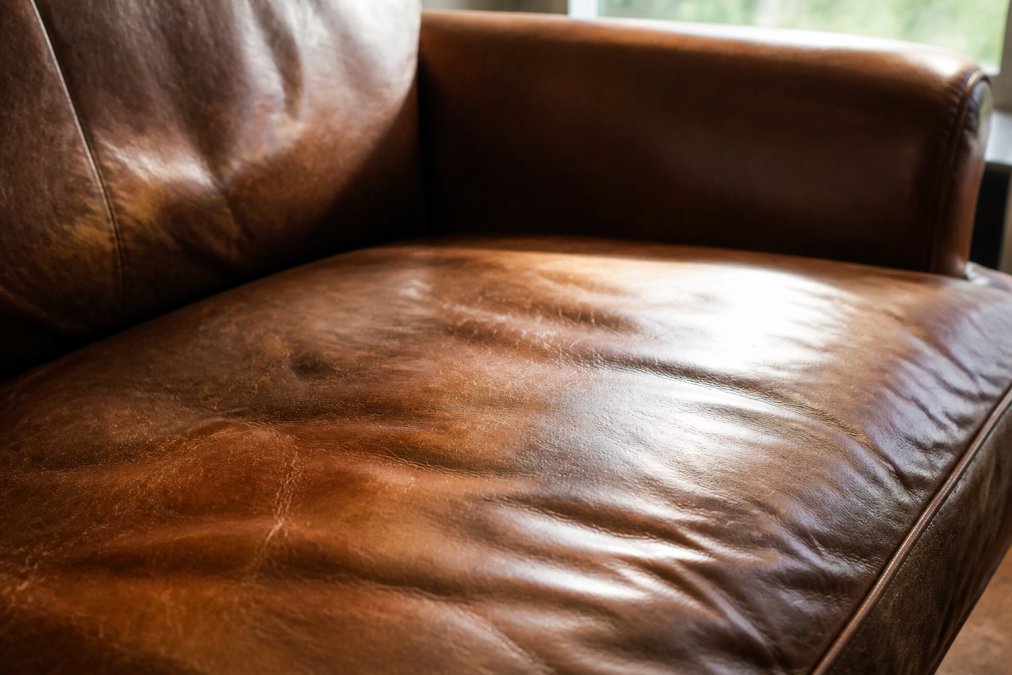
The Patina Process: How Full Grain Leather Ages
Handcrafted Leather Furniture Warranty Guide
A handcrafted leather furniture warranty guide matters because the warranty tells you what the maker believes about its own construction. Structural coverage on frames, springs, and joinery is the number that counts. Surface and finish exclusions are normal, since leather is a natural material that will mark and change with use.
Full Grain Leather Sofas for Pets, Climate, and Real Life
Most buying guides treat full grain leather as a single monolithic material and skip the two questions real households ask: will it survive my dog, and will it survive my climate?
Full Grain Leather and Pets: A Claw-Resistance Reality Check
No leather is claw-proof, and any guide claiming otherwise is selling something. What full grain offers is a surface with no woven threads to snag and no applied finish to chip away. When a dog launches off a cushion, the claw either skims across the grain or leaves a shallow mark, it does not pull a thread the way chenille or linen will.
A few practical patterns most owners land on:
- Trim nails every two to three weeks. This is the variable you control. A dog with rounded nails does almost no damage to full grain; a dog with long, sharp nails will eventually leave tracks.
- Keep a microfiber cloth and a leather-safe conditioner on hand. Light scratches buff out in seconds when addressed early.
- Choose darker, aniline-dyed full grain if you have a heavy shedder or a large breed. Pigmented and aniline finishes both hide incidental marks, but darker tones mask them further.
- Skip the "pet-proof" marketing language. There is no standardized pet-resistance rating for leather in the furniture industry. Evaluate the hide, not the label.
How Full Grain Leather Performs in Humid and Dry Climates
Full grain leather is hygroscopic, it absorbs and releases moisture from the air. That property explains almost everything about how it behaves across climates.
The Sustainability Angle Most Guides Skip
Full grain uses the outermost layer of the hide intact, meaning less sanding, less buffing, and fewer pigmented coatings than corrected or split leathers, fewer processing steps and lower chemical and energy inputs per square foot. The hide is also a byproduct of the food industry, so choosing full grain over synthetic upholstery is a question of whether you want a petroleum-derived textile or a material that would otherwise be discarded.
Full grain leather is not pet-proof or climate-proof, it is pet-tolerant and climate-responsive. Trimmed nails, a microfiber cloth, and one conditioning session a year cover the vast majority of real-world risk, in almost any climate.
Frequently Asked Questions
What makes full grain leather superior to top grain or split leather?
Full grain leather uses the entire hide surface without sanding or buffing, preserving the tightest fiber density and natural markings. Top grain is sanded to remove imperfections, which thins the surface, while split leather comes from lower layers with weaker fibers. This means full grain resists wear and tear better, develops richer patina, and holds its tensile strength for decades rather than years.
Does full grain leather get more comfortable over time?
Yes. Full grain leather molds to your body through use, and its natural porosity allows it to breathe better than pigmented or protected leathers. As the fibers relax, the sofa becomes more supple and conforms to your seating position. The Frannie Leather Sofa from Hedi's Furniture, for example, is built with eight-way hand-tied construction that works with the leather to deliver comfort that improves with age.
Is full grain leather easy to maintain in a busy household?
It is easier than most people expect. Dust weekly with a dry cloth, wipe spills immediately with a damp cloth, and apply a leather conditioner every six to twelve months. Avoid harsh chemicals and direct sunlight. Full grain leather's natural stain resistance handles everyday accidents well, and its durability means it stands up to daily use without cracking or peeling like lower grades.
Why is full grain leather considered a sustainable furniture choice?
Full grain leather is a byproduct of the meat industry, so it makes use of a material that would otherwise be discarded. Because it lasts for decades rather than needing replacement every few years, it reduces the waste associated with fast furniture. Hedi's Furniture sources full grain leathers and builds sofas with solid wood frames, creating investment pieces that stay out of landfills.