

Table of Contents
- Why Handcrafted Sofas Outlast Mass-Produced Furniture
- Quick Comparison: Top Handcrafted Sofas for Longevity
- 1. Frannie Leather Sofa: Best Overall for Timeless Durability
- 2. Ashby 86" Sofa: Best for Custom Comfort
- 3. Bradford 88" Sofa: Best Value in Handcrafted Quality
- 4. Peretti 92" Sofa: Best for Luxurious Lounging
- 5. Moreau 98" Sofa: Best for Spacious Living Rooms
- How to Tell If a Sofa Is High Quality: A Buyer's Checklist
- Frequently Asked Questions
Last Updated: October 4, 2026
Why Handcrafted Sofas Outlast Mass-Produced Furniture
The best handcrafted sofas for longevity are built around a simple principle: every structural layer is made to be repaired, not replaced. Mass-produced sofas often hide particleboard frames, stapled joints, and sinuous wire suspensions behind fabric. Those shortcuts fail quietly, usually within five to seven years of daily use. The reason is not mysterious, it comes down to four construction decisions that most product pages never explain.
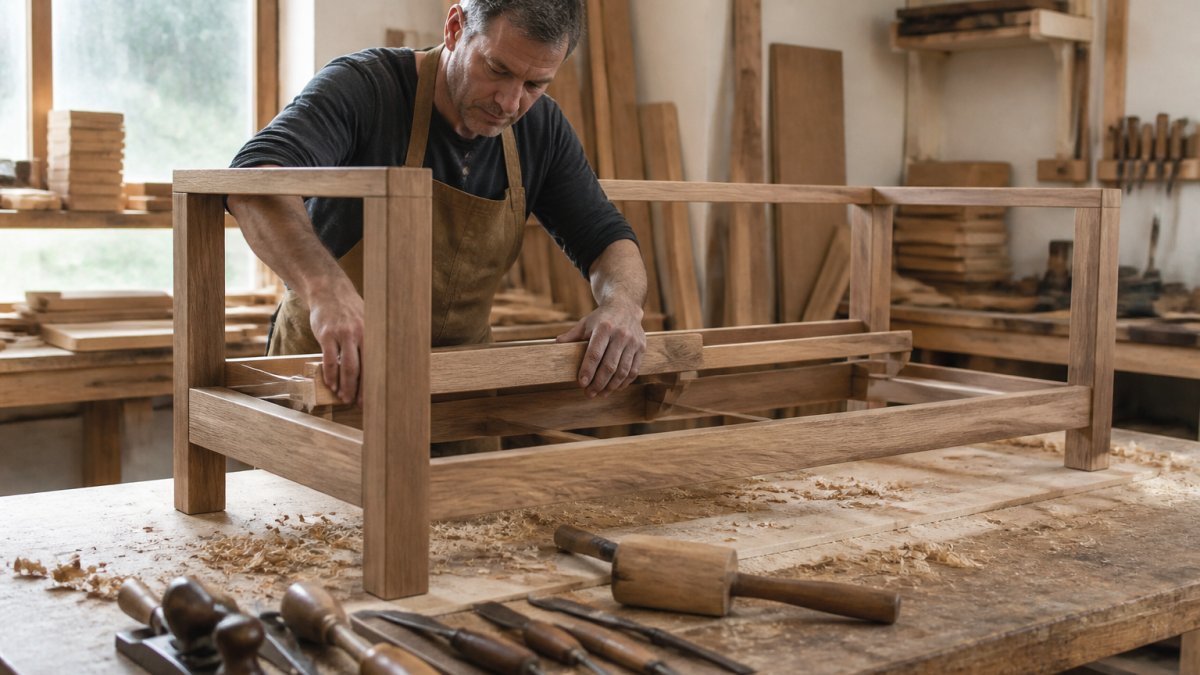
1. The frame: kiln-dried hardwood versus particleboard. Kiln-drying pulls moisture content down to a range that keeps wood from warping, shrinking, or splitting as indoor humidity swings through the seasons. Particleboard and medium-density fiberboard (MDF) are engineered panels held together with adhesive and wood dust; they cannot hold a screw or a joint under repeated load, and once a corner loosens there is no way to tighten it. A kiln-dried hardwood frame, maple, oak, ash, or a comparable dense species, holds fasteners and joinery tight for decades.
2. The joints: how the frame is actually fastened. This is the single most overlooked durability factor, and most competitors skip it entirely. A frame is only as strong as the way its rails meet its legs.
- Mortise-and-tenon: one member is cut with a projecting tenon that seats into a matching mortise cut in the other, then pinned or glued. The joint resists twisting and racking because the wood itself carries the load, not just the adhesive.
- Dowel joints: hardwood dowels driven through both members add shear strength and are common at corner blocks.
- Staples and screws alone: fast to assemble, and the first thing to loosen. A stapled corner relies on the staple's grip in the wood; once the wood fibers crush, the joint moves.
A useful showroom test: ask what happens at the corners. If the answer is "corner blocks, glued and screwed, with dowels," the frame can be re-tightened and restored. If the answer is "stapled," it cannot.
3. The suspension: 8-way hand-tied versus sinuous wire. Sinuous (zigzag) wire springs are one continuous piece of steel clipped to the frame. They are inexpensive and they work, until the clips fatigue or the wire takes a permanent set, at which point the seat develops a dip that cannot be corrected without rebuilding. Eight-way hand-tied springs are individual coils tied front-to-back, side-to-side, and diagonally with heavy twine to a webbed frame. The eight directions of tie are what distribute weight evenly across the seat instead of concentrating it under the heaviest sitter. Critically, hand-tied springs can be retied during restoration, a sinuous system generally cannot.
4. The cushion core: density is the number that matters. Cushion foam is rated in density (pounds per cubic foot) and in firmness (Indentation Load Deflection, or ILD). Low-density foam feels plush in the showroom and collapses within a few years because there is simply less material per cubic foot to resist compression. High-density foam and down-blend wraps hold their loft far longer. A down-blend seat needs regular fluffing to keep its shape; a high-density foam core needs almost none.
5. The fabric: ask for the double rub count. Upholstery wear is measured by the Wyzenbeek test, which reports how many double rubs a fabric withstands before showing noticeable wear. Residential upholstery commonly falls in the 15,000 to 30,000 range; heavy-duty and contract-grade fabrics run 30,000 and above. A higher double rub count is not a guarantee of longevity, weave and fiber matter too, but it is the closest thing the industry has to a standardized wear number, and it is the number most listings omit.
Quick Comparison: Top Handcrafted Sofas for Longevity
Below is a side-by-side look at five handcrafted sofas we build, ranked by how well each serves long-term durability and daily comfort.
| Sofa | Price | Frame & Suspension | Best For |
|---|---|---|---|
| Frannie Leather Sofa | $6,500 | Solid wood frame, 8-way hand-tied | Timeless durability |
| Ashby 86" Sofa | $4,950 | Hardwood frame, 8-way hand-tied | Custom comfort |
| Bradford 88" Sofa | $2,975 | Hardwood frame, premium cushioning | Value |
| Peretti 92" Sofa | $6,050 | Hardwood frame, 8-way hand-tied | Luxurious lounging |
| Moreau 98" Sofa | $3,500 | Hardwood frame, premium cushioning | Spacious rooms |
How We Evaluated These Sofas
We ranked each sofa on four measures: frame material and joinery, suspension type, upholstery durability, and how easily the piece can be restored later. Every sofa here is 100% bench-made in the USA and covered by our Lifetime Warranty Guarantee.

1. Frannie Leather Sofa: Best Overall for Timeless Durability
The Frannie Leather Sofa is our top pick for longevity because full-grain leather and a solid wood frame age together rather than wearing out. It is built on a solid wood frame with eight-way hand-tied construction and upholstered in premium USA-made top grain leather that develops a rich patina while resisting wear.
Each piece is custom made to order, so you can tailor dimensions and leather finish to your space. Priced at $6,500.
Pros: Full-grain leather improves with age; repairable frame; custom sizing. Cons: Leather requires periodic conditioning; higher upfront cost.
2. Ashby 86" Sofa: Best for Custom Comfort
For buyers who want to choose their own fabric and seat feel, the Ashby 86" Sofa offers the most flexibility. It pairs premium cushioning with hardwood frames and a traditional 8-way hand-tied spring system, and it is 100% bench-made in the USA with a range of fabric options. Priced at $4,950.

Pros: Wide fabric selection; proven spring suspension; comfortable at 86 inches wide. Cons: Fabric, not leather, so it shows stains more readily.
3. Bradford 88" Sofa: Best Value in Handcrafted Quality
The Bradford 88" Sofa delivers handcrafted construction at the lowest price in this group. It uses hardwood frames and premium cushioning, is 100% bench-made in the USA, and comes in many fabric options. For a first serious investment piece, it is the smart entry point. Priced at $2,975.

Pros: Lowest price here; hardwood frame; customizable fabric. Cons: No 8-way hand-tied springs at this price tier.
4. Peretti 92" Sofa: Best for Luxurious Lounging
When comfort is the priority, the Peretti 92" Sofa stands out. It combines premium cushioning, hardwood frames, and a traditional 8-way hand-tie spring system, with comfort-down seat cushions and blendown loose-pillow back cushions. Priced at $6,050.
Pros: Down-blend cushions; deep 23-inch seat; hand-tied springs. Cons: Down cushions need regular fluffing to keep their loft.
5. Moreau 98" Sofa: Best for Spacious Living Rooms
For large rooms that need a proportionate anchor, the Moreau 98" Sofa fills the space without looking bulky. It is built with premium cushioning and hardwood frames and is 100% bench-made in the USA, available in many fabrics and leathers. Priced at $3,500.
Pros: Generous 98-inch width; hardwood frame; fabric and leather options. Cons: Too large for smaller living rooms.
How to Tell If a Sofa Is High Quality: A Buyer's Checklist
Use this checklist in any showroom or product page. It answers the question of how to tell if a sofa is high quality without relying on marketing claims, and, where possible, it tells you how to verify each item rather than just what to look for.
- Frame is kiln-dried hardwood, not particleboard or softwood. How to verify: lift one end. A hardwood frame is heavy for its size. Ask directly what species and whether it is kiln-dried. "Engineered wood" or "select hardwoods" in a spec sheet usually means a mix that includes softer species.
- Joints are mortise-and-tenon or doweled, not stapled. How to verify: ask what is used at the corners. Corner blocks that are glued and screwed, with dowels, are the durable answer. Staples alone are not.
- Suspension is 8-way hand-tied or a quality sinuous system. How to verify: press down firmly on the seat. Hand-tied springs give even resistance across the whole seat; a tired sinuous system dips in the middle. Ask whether the springs can be retied later.
- Cushion core is high-density foam or a down blend. How to verify: ask for the foam density in pounds per cubic foot and the ILD (firmness) rating. Higher density means more material resisting compression, which is what keeps a seat from bottoming out.
- Upholstery has a high double rub count for wear resistance. How to verify: ask for the Wyzenbeek double rub result. Residential fabrics commonly run 15,000 to 30,000; heavy-duty fabrics run 30,000 and above. If the number is not available, treat that as a signal.
- Frame corners are reinforced and blocked. How to verify: turn the sofa over if you can, or ask for a photo of the underside. Look for corner blocks and a dust cover that can be removed for inspection.
- The piece can be reupholstered or restored later. How to verify: ask whether the frame is designed to be taken apart and rebuilt, and whether the manufacturer offers reupholstery or replacement cushions. A sofa that can be restored is a sofa that can outlive its first fabric.
Maintenance that actually extends life. Keep the sofa out of direct sunlight, which fades and weakens fabric fibers. Rotate and flip seat cushions monthly so wear spreads evenly across the foam rather than concentrating in one spot. Vacuum upholstery on a low setting to lift grit that abrades fibers from below. Condition leather once or twice a year with a product made for the finish on your hide, over-conditioning can clog the grain as readily as under-conditioning dries it.
Repairability is the longevity multiplier. The most durable sofa is not the one that never wears, it is the one that can be fixed. A frame with serviceable joints can be re-tightened. Hand-tied springs can be retied. Cushion cores can be replaced without replacing the sofa. When you evaluate a piece, ask one final question: if this sofa sags in eight years, what is the repair path? If the answer is "buy a new one," the durability claim is marketing. If the answer is "we retie the springs and replace the cushions," you are looking at furniture built to be kept.
Frequently Asked Questions
What construction features indicate a sofa will last for decades?
Look for a solid wood frame, eight-way hand-tied springs, and high-density foam cushions. A kiln-dried hardwood frame resists warping, while mortise-and-tenon joinery adds structural integrity. Hand-tied springs distribute weight evenly and maintain resilience. These features, found in handcrafted sofas, are the foundation of a piece that can last 20 years or more with proper care.
Are full-grain leather sofas more durable than fabric options?
Full-grain leather typically outlasts most fabrics because it resists wear, develops a patina, and is easy to clean. However, durability also depends on the frame and cushion construction. A handcrafted sofa with a solid wood frame and eight-way hand-tied springs, like the Frannie Leather Sofa, combines premium top-grain leather with robust engineering for exceptional longevity.
How do I maintain a handcrafted sofa to ensure it lasts a lifetime?
Rotate cushions monthly to distribute wear, vacuum fabric upholstery regularly, and keep leather away from direct sunlight. For leather, clean with a soft cloth and condition every 6-12 months. Avoid harsh chemicals. Check the frame and springs annually for loose joints or sagging. With these simple steps, a handcrafted sofa from Hedi's Furniture can remain comfortable and beautiful for generations.
What is the difference between mass-produced and handcrafted sofa frames?
Mass-produced frames often use softwoods, particleboard, or stapled joints that loosen over time. Handcrafted frames use kiln-dried hardwoods and traditional joinery like mortise-and-tenon, which lock pieces together for superior frame stability. This craftsmanship, combined with eight-way hand-tied springs, means a handcrafted sofa resists sagging and squeaking far longer than a mass-produced alternative.
Choosing a sofa is a long-term decision, and the wrong frame material will cost you far more than the price tag suggests. Hedi's Furniture builds every sofa on kiln-dried hardwood frames with 8-way hand-tied suspension, covers each piece with our Lifetime Warranty Guarantee, and includes complimentary design guidance to help you match fabric, leather, and scale to your room. Shop the sofa collection and invest in a piece designed to last for generations.