

Table of Contents
- Handcrafted vs. Mass-Produced Furniture: A Durability Comparison
- Solid Wood vs. Engineered Wood Furniture Durability
- Best Furniture Joinery Techniques for Longevity
- How to Identify High-Quality Furniture Construction
- Stress Testing and Structural Integrity: What the Data Shows
- Lifecycle Cost and Second-Hand Market Value of Handcrafted Furniture
- Frequently Asked Questions
Last Updated: September 13, 2026
Handcrafted vs. Mass-Produced Furniture: A Durability Comparison
The question of handcrafted vs mass produced furniture durability comes down to how each piece is built, not how it looks in a showroom. Handcrafted furniture is built around a solid hardwood frame joined with traditional techniques, while mass-produced furniture typically relies on particle board, veneer, and mechanical fasteners that loosen over time. This guide from Hedi's Furniture breaks down the construction differences, joinery methods, and long-term costs that actually determine how long a piece lasts. The gap shows up fastest in daily-use items like sofas, where frame and spring systems take constant stress.
The core distinction is structural. A handcrafted sofa uses a hardwood frame and an eight-way hand-tied spring system, both of which hold their shape under repeated load (pubmed.ncbi.nlm.nih.gov). A mass-produced equivalent often uses stapled particle board and sinuous wire springs, which are cheaper to assemble but compress and sag sooner.
Solid Wood vs. Engineered Wood Furniture Durability
Solid wood furniture outlasts engineered wood in almost every structural application. Solid hardwood resists racking, holds joinery, and can be sanded and refinished multiple times, while engineered panels like particle board and MDF rely on resin binders that fail at stress points.
That difference matters most where furniture takes load: sofa frames, table aprons, and chair legs. Solid wood tolerates seasonal humidity swings and repeated stress without delaminating. Engineered panels can split at screw and cam-lock points, and once particle board swells from moisture, it cannot be repaired.
Wood grain also tells you what you are buying. A solid hardwood frame shows continuous grain through cut edges; a veneered panel shows a thin surface layer over a different core. Many buyers find that the frame material alone predicts how a piece will look in ten years.
| Material | Typical Use | Repair Outlook | Lifespan Under Daily Use |
|---|---|---|---|
| Solid hardwood | Frames, legs, aprons | Sandable, re-glueable | Decades |
| Plywood | Structural panels | Limited refinishing | Moderate |
| Particle board | Budget frames, flat-pack | Not repairable once swollen | Short |
| MDF | Painted panels | Hard to re-fasten | Short to moderate |
| Veneer over solid core | Visible surfaces | Refinishable with care | Long if core is sound |
Best Furniture Joinery Techniques for Longevity
Traditional joinery outlasts mechanical fasteners because it distributes stress across the wood itself rather than concentrating it at a screw or cam fitting. A dovetail joint, mortise and tenon, or doweled corner resists racking because the geometry locks the members together.
Mechanical fasteners are not automatically bad, but they behave differently. Screws, bolts, and cam locks hold well when new and loosen as wood expands and contracts seasonally (fs.usda.gov). On a mass-produced sofa, that loosening shows up as a creaking frame or a wobbling arm within a few years of regular use.
For anyone comparing pieces, the joinery question is simple: can you see or feel how the parts connect? Handcrafted work usually makes that visible in the frame, the corner blocks, and the way seams are finished. Mass-produced furniture often hides the connection behind staples and glue.
How to Identify High-Quality Furniture Construction
You can judge furniture construction in about two minutes with a short inspection routine. Focus on the frame, the joints, and the finish rather than the fabric or the styling.
- Lift one corner: a solid frame stays rigid, a weak one flexes
- Check under the seat: look for hardwood, corner blocks, and hand-tied springs
- Press the arms and back: movement at the joint signals loose fasteners
- Look at cut edges: continuous grain means solid wood, layered edges mean veneer
- Inspect drawer and door joints: dovetails and mortise-and-tenon outlast staples
- Run a hand along the finish: hand-finished surfaces feel even, with no drips or overspray
- Ask what the frame is made of: a specific hardwood answer is a good sign
Finish quality is the easiest shortcut. A hand-finished piece has consistent sheen and no hard edges where surfaces meet. Factory finishes are usually uniform but thin at corners, which is exactly where wear and tear starts.
Stress Testing and Structural Integrity: What the Data Shows
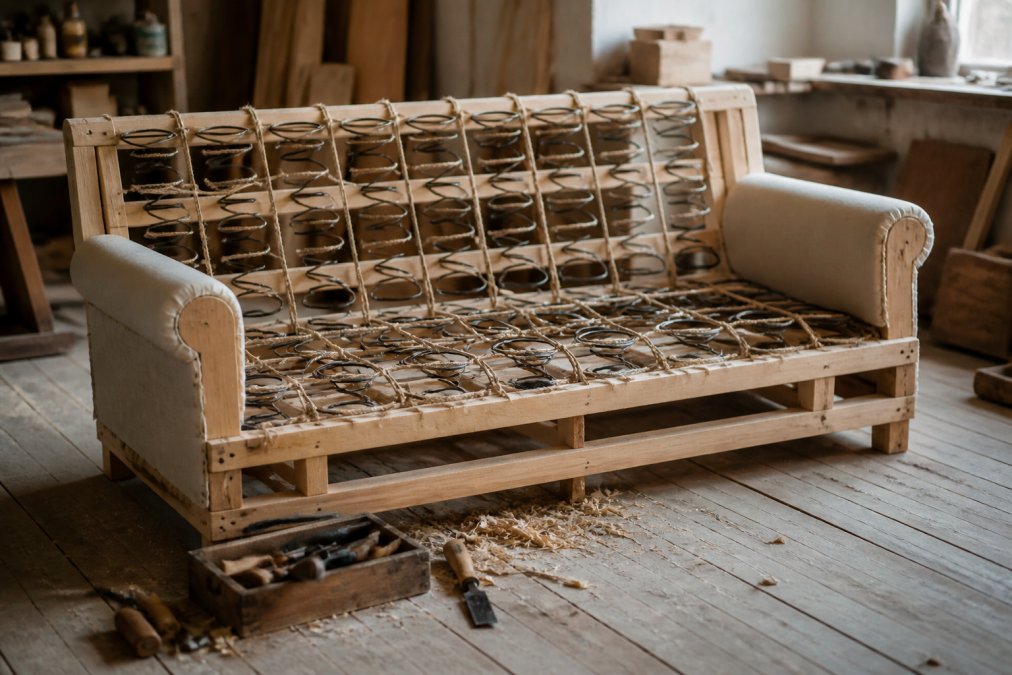
Structural integrity is best understood through how a piece behaves under repeated load, not how it looks on day one. Furniture testing labs and manufacturers evaluate seating with cyclic load tests, applying thousands of simulated sit-downs to measure frame deflection, joint separation, and spring fatigue. The pattern these tests reveal is consistent: failures cluster at joints and spring attachment points, not in the wood itself.
How Load Actually Moves Through a Frame
When you sit down, your weight enters the seat deck, travels through the springs, and gets distributed into the rails and legs. Two forces matter most:
- Vertical load (compression): the seat deck and spring system absorb downward force. Sinuous wire springs, common in mass-produced sofas, are clipped to a thin rail and deform along their length. Eight-way hand-tied springs are tied to each other and to the frame with twine, so load spreads across the whole deck instead of concentrating at clip points.
- Shear and racking (side-to-side): leaning on an arm or dragging a sofa across a floor pushes the frame out of square. A mortise-and-tenon or doweled corner resists this because the tenon is captured inside the mortise and the shoulders bear against the rail. A butt joint held by staples or cam locks relies on the fastener alone, and fasteners loosen as wood shrinks and swells with the seasons.
Why Joinery Type Changes the Failure Point
A dovetail joint and a stapled butt joint can both hold a drawer front on day one. Under repeated cycling they diverge:
- Dovetails and mortise-and-tenon: the interlocking geometry means the wood itself carries the load. Even if glue fails, the joint stays mechanically captured. It can be re-glued and re-clamped.
- Staples, screws, and cam locks: the fastener carries the load. Each cycle widens the hole slightly. Once the hole is oversized, the fastener has nothing to bite, and particle board or MDF cannot be re-fastened reliably.
This is why a hardwood frame with traditional joinery and an eight-way hand-tied spring system holds up where stapled construction does not. It also explains why repairability matters: a joint that can be re-glued and re-clamped has a second life; a particle board panel that has swollen and crumbled does not.
For buyers, the practical takeaway is to weight construction over surface. Upholstery and finish are replaceable. The frame is not.
Lifecycle Cost and Second-Hand Market Value of Handcrafted Furniture
Handcrafted furniture usually costs more upfront and less per year of use. The way to see that clearly is to divide purchase price by years in service, the cost-per-year method, and then subtract whatever the piece is worth when you sell it.
The Cost-Per-Year Framework
A mass-produced sofa that needs replacing after a few years of daily use often costs more in total than a handcrafted piece that stays in service for decades (the EPA). The table below shows the math for two representative scenarios. The dollar figures are illustrative examples, not quotes, substitute your own prices and expected lifespans.
| Factor | Handcrafted (example) | Mass-Produced (example) |
|---|---|---|
| Upfront cost | $5,000 | $1,200 |
| Expected lifespan under daily use | 20 years | 5 years |
| Replacements needed over 20 years | 0 | 3 |
| Total 20-year spend | $5,000 | $4,800 |
| Cost per year of use | $250 | $240 |
| Resale value at year 20 | Retains meaningful value | Effectively zero |
| Effective cost per year after resale | Lower | Higher |
The upfront gap narrows sharply once replacements are counted, and the resale line is what tips the comparison. A handcrafted piece that can be refinished and reupholstered still has a buyer at year 20. A flat-pack or veneered particle board piece that has swollen, sagged, or lost its fasteners usually has none.
Why Resale Value Diverges
Second-hand value separates the two categories because it depends on whether a future buyer can repair the piece:
- Solid wood and traditional joinery: a buyer can sand, refinish, re-glue, and reupholster. That repairability is what keeps a used market alive.
- Particle board and veneer over particle board: once the core swells from moisture or the fastener holes strip, there is no repair path. The piece is landfill, not inventory.
- Brand and provenance: bench-made pieces with documented construction and a transferable warranty hold value better than anonymous imports, because the buyer knows what is inside the frame.
What to Ask Before You Buy
When comparing two pieces at similar prices, ask about the frame and spring system, since handcrafted vs mass produced furniture durability is decided there. Those two specs predict lifespan better than fabric, color, or brand name. Then run the cost-per-year math yourself: divide price by expected years, add the cost of any likely replacement, and subtract the resale you could realistically recover. That single calculation is the most honest durability comparison you can make.
Hedi's Furniture builds its sofas on hardwood frames with eight-way hand-tied spring systems and backs them with a Lifetime Warranty Guarantee, which changes the lifecycle math for anyone planning to keep a piece long term. The FRANNIE SOFA at $5,500 and the ASHBY 86" SOFA at $4,950 are both bench-made in the USA with customizable fabrics. For larger rooms, the Signature Elements Sectional at $7,950 uses a solid wood frame and the same hand-tied spring system, and the RADCLIFFE SWIVEL CHAIR at $3,750 offers full-grain leather options on a solid wood frame.


Frequently Asked Questions
What are the primary structural differences between handcrafted and mass-produced furniture?
Handcrafted furniture typically uses solid wood frames and traditional joinery like mortise and tenon or dovetail joints, which resist stress without relying on glue alone. Mass-produced pieces often use particle board or veneers held together with mechanical fasteners and adhesives. These differences affect handcrafted furniture durability, especially under daily wear and tear. Handcrafted frames also allow for repairability, while mass-produced components may fail permanently once cracked or stripped.
Does solid wood furniture always outlast engineered wood?
Not automatically. Solid wood furniture durability depends on the species, joinery, and finish quality. A poorly made solid wood piece can warp or crack if the wood wasn't properly dried. Engineered wood like high-quality plywood can perform well in some applications, but particle board and MDF tend to sag or crumble under repeated stress. For long-term value, solid wood with traditional joinery is generally more repairable and holds up better to wear and tear.
How do joinery techniques affect the durability of a dining table?
Joinery determines how well a table resists racking, wobbling, and seasonal wood movement. Mortise and tenon joints and dovetails create interlocking mechanical connections that hold up over decades. Tables assembled with screws, dowels, or staples may loosen with repeated use. When evaluating best furniture joinery techniques for longevity, look for joints that fit tightly without visible gaps and avoid pieces where fasteners are the primary structural support.
Is handcrafted furniture worth the higher price point for daily use?
For daily use, handcrafted furniture often costs less over time. A mass-produced sofa might need replacing every 5 to 7 years, while a handcrafted piece with a hardwood frame and eight-way hand-tied springs can last 15 to 25 years or more. The upfront cost is higher, but the lifecycle cost per year can be lower. Handcrafted pieces also tend to hold resale value, making them a more sound financial decision for long-term ownership.
How does the finish on handcrafted furniture compare to factory-applied coatings?
Hand-finished surfaces are typically applied in thinner, more controlled layers, which allows the wood grain to show through and makes spot repairs easier. Factory finishes are often thicker and more uniform, but they can chip in large flakes and are harder to touch up. For handcrafted furniture durability, a hand-rubbed oil or lacquer finish that penetrates the wood offers better protection against wear and tear and ages more gracefully over time.
Choosing furniture that lasts is really a question of what you are paying for: a surface that looks right today, or a frame that holds up for years. Hedi's Furniture builds each piece on solid wood frames with traditional joinery and eight-way hand-tied spring systems, covered by a Lifetime Warranty Guarantee, with complimentary design guidance to help you plan a room that ages well. Shop the sofa collection at Hedi's Furniture and invest in furniture designed to last for generations.