

Table of Contents
- Is Solid Wood Furniture Worth It? The Real Answer
- Solid Wood vs Veneer Furniture: Key Differences
- How to Identify Solid Wood Furniture
- The Long-Term Value: Cost, Durability, and Resale
- Solid Wood Furniture Maintenance Tips for Longevity
- Environmental Impact and Sustainability
- Frequently Asked Questions
Last Updated: September 12, 2026
Is Solid Wood Furniture Worth It? The Real Answer
Solid wood furniture is worth it when you plan to keep a piece for more than a decade, because the upfront cost buys repairability and structural integrity that veneered and particle board construction cannot match. At Hedi's Furniture, we build sofas, tables, and case goods from solid woods, natural fibers, and full-grain leathers, so we have a stake in this argument. But the honest answer depends on how you use the piece, how long you keep it, and whether you will maintain it.
Solid wood wins on longevity and resale, loses on upfront price, and needs a climate-controlled home to perform at its best. Here is each trade-off, with numbers rather than marketing language.
Solid Wood vs Veneer Furniture: Key Differences
The core difference is what sits under the surface. Solid wood furniture is milled from a single species throughout its structural members, while veneered furniture wraps a thin slice of real wood over plywood, MDF, or particle board. That distinction drives weight, repairability, price, and humidity behavior.
A few practical contrasts:
- Structure: Solid wood legs, rails, and frames can be sanded and refinished repeatedly. A veneer surface can typically be refinished once, and only if the veneer layer is thick enough.
- Movement: Solid wood expands and contracts with seasonal moisture changes. Engineered cores are more dimensionally stable but cannot be sanded back to bare wood.
- Weight and feel: Solid pieces are heavier and often use joinery such as mortise-and-tenon or dovetails rather than staples and glue blocks.
- Cost: Solid construction usually costs more upfront because the raw material is more expensive and the labor is slower.
None of this makes veneer automatically bad. High-quality plywood with a thick veneer face is a legitimate, stable material, and many well-made contemporary pieces use it deliberately. The problem is cheap particle board dressed up to look like solid oak.
| Factor | Solid Wood | Veneer over Plywood | Veneer over Particle Board |
|---|---|---|---|
| Refinishing | Multiple times | Once, if thick | Not practical |
| Moisture behavior | Moves seasonally | Stable | Swells and crumbles |
| Typical lifespan | Decades | 10-20 years | 3-7 years |
| Repairability | High | Moderate | Low |
| Resale value | Retains value | Modest | Minimal |
How to Identify Solid Wood Furniture
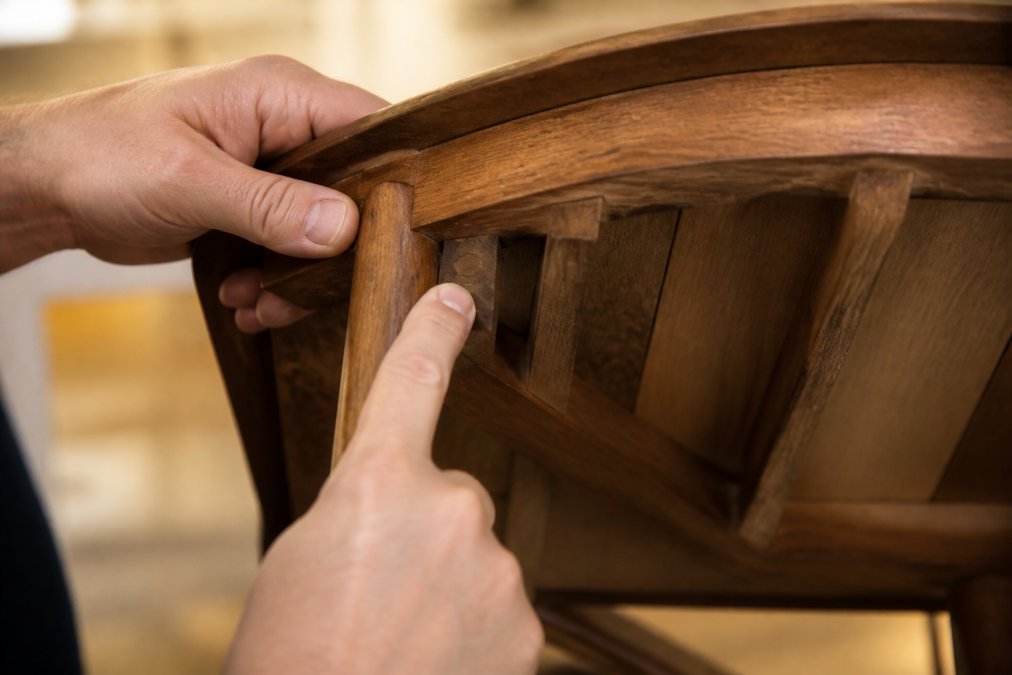
You can identify solid wood furniture by checking the underside, back panels, and end grain. Real wood shows continuous grain that wraps around edges; veneer shows a repeating pattern or visible seam.
Bring a flashlight and check these five spots before you buy:
- Underside of the tabletop or seat frame. Grain that continues from the top surface around the edge signals solid wood; a sharp change signals veneer.
- End grain. A solid leg or rail shows tight growth rings; particle board shows a speckled, glued-together texture.
- Back panels and drawer bottoms. Thin, flexible panels usually mean engineered construction.
- Joinery at the corners. Dovetails, mortise-and-tenon, and doweled joints suggest real woodworking; staples and corner blocks suggest assembly-line construction.
- Weight. Solid wood is noticeably heavier per cubic foot than a hollow core.
The Long-Term Value: Cost, Durability, and Resale
Solid wood furniture usually costs more upfront and less over time, but only if you run the numbers on the right species and lifespan. What matters is cost per year of use, and that figure swings widely between softwoods like pine and hardwoods like oak, maple, or walnut.
Cost per year of use
The honest way to compare furniture is to divide the purchase price by the years you expect to own it:
- A particle board bookcase replaced every five years costs more per year than a solid hardwood bookcase kept for 25 years, even when the hardwood piece costs four to five times as much at checkout.
- A softwood piece (pine, spruce) is cheaper upfront than hardwood, dents more easily, and often needs refinishing sooner, so its cost-per-year advantage narrows in high-traffic spots.
- A hardwood piece (oak, maple, cherry, walnut) has the highest upfront cost and the lowest cost per year when it stays in the household for decades.
The variable that breaks the math is you. If you move every three years, change your style often, or buy for a rental, the long-horizon argument collapses and a well-made veneer piece is the smarter financial call.
Hardwood vs. softwood: the species question most guides skip
"Solid wood" is not one material. The two broad categories behave and price differently:
| Category | Common species | Hardness (Janka scale, approx.) | Typical behavior |
|---|---|---|---|
| Softwood | Pine, spruce, fir, cedar | 400-900 lbf | Dents and scratches more easily; cheaper; good for painted or rustic pieces |
| Hardwood | Oak, maple, cherry, walnut, ash | 1,000-1,500+ lbf | Resists daily wear; takes stain and finish well; higher cost |
The Janka scale measures the force required to embed a steel ball halfway into the wood, the higher the number, the more dent-resistant the surface. A dining table that hosts homework, holiday meals, and hot dishes benefits from a hardwood top. A painted pine dresser in a guest room does not, and paying hardwood prices for it is money wasted.

Where resale actually comes from
Resale value in solid wood is not automatic. It tracks three things:
- Species and construction. A solid walnut or oak piece from a known maker holds value. An unmarked solid pine piece from a mass retailer usually does not.
- Form. Classic silhouettes, pedestal tables, Windsor-style chairs, simple case goods, resell better than trend-driven shapes, because the buyer pool is larger and less time-sensitive.
- Condition. A piece that can be sanded and refinished has a floor under its value. A piece with a failing veneer or swollen particle board core has none.
That last point is the mechanism behind the whole argument. Refinishing converts a used piece back into a desirable one. A solid oak dining table with a scratched top is a weekend project. A veneered table with a lifted edge is a repair most buyers will not attempt.
A worked example
Consider two dining tables used daily by a family of four:
- Table A: solid oak top and base, higher upfront cost, expected service life of 25+ years with one refinish around year 12.
- Table B: veneer over particle board, roughly one-quarter the upfront cost, expected service life of 5-7 years before the top swells or the veneer lifts at the seams.
Over 25 years, Table A is bought once. Table B is bought three to five times, each replacement carrying its own delivery, assembly, and disposal cost. Table A's per-year figure is lower in most scenarios, but only if the household keeps it. If the family relocates across the country twice in that window, the heavier solid table becomes a liability, and the math flips.
That is the real answer: solid wood is worth it when your ownership horizon is long enough to amortize the upfront cost, and when the species matches how the piece will actually be used.
A note on the pieces in our own catalog: the Sydney Bookcase is solid mango, a hardwood, which is why it can take daily loading and still be sanded back if it ever needs it. The OTAGO Oval Dining Table pairs a solid wood base with an oak veneer top, a deliberate engineering choice for a large surface where dimensional stability matters more than refinishing depth. Neither is automatically the right call for every buyer; both are the right call for specific use patterns.

Solid Wood Furniture Maintenance Tips for Longevity
Solid wood furniture maintenance comes down to three habits: control indoor humidity, clean with a barely damp cloth, and refresh the finish before the wood dries out. Skip any and you accelerate the exact problems solid wood is supposed to avoid.
- Keep indoor humidity between roughly 35% and 55% (the EPA). Below that range, wood loses moisture and shrinks, opening joints. Above it, wood swells and can warp.
- Keep pieces out of direct sun and away from heating vents. Uneven drying causes cupping and finish checking.
- Dust with a soft, dry cloth weekly. Grit acts like sandpaper on a lacquer or oil-based finish.
- Wipe spills immediately. Water rings form when moisture sits on the surface, not from the spill itself.
- Re-oil or re-wax annually if the finish is oil-based. Lacquer and polyurethane finishes need less frequent attention.
- Use felt pads and coasters. Prevention costs nothing; refinishing costs real money.
A common mistake is over-oiling. More oil does not mean more protection, and excess product attracts dust and leaves a gummy film. Follow the maker's guidance, not a general rule from the internet.
Environmental Impact and Sustainability
Most furniture guides stop at "look for certified wood." That is necessary but not sufficient, and it misses the comparison that actually decides the environmental question: what happens to the piece at end of life, and how many times you replace it.
The replacement multiplier
The dominant environmental cost of furniture is not the material in a single piece, it is how many pieces you buy over time. A solid wood table kept for 30 years is one table. A particle board table replaced every five years is six tables, six manufacturing cycles, six shipments, and six disposal events. Even if each fast-furniture table carries a lower embodied footprint, the multiplier usually erases that advantage.
The relevant question is not "is solid wood greener per pound" but "is solid wood greener per decade of service."
End-of-life: the disposal gap
Where furniture ends up matters as much as where it came from:
- Solid wood can be refinished, reupholstered, cut down into smaller pieces, or sold. When it finally leaves a household, it is still a usable material, often to a second owner, a furniture restorer, or a woodworker.
- Veneer over plywood can sometimes be refinished once and is often accepted by secondhand buyers if the surface is intact. Once the veneer fails, the piece is usually finished.
- Veneer over particle board has almost no end-of-life path. Swollen panels cannot be sanded, glued reliably, or structurally repaired. The piece goes to a landfill or, at best, to a municipal bulky-waste pickup.
The practical takeaway: the more engineered the core, the shorter the realistic second life. That is a disposal-rate issue, not just a materials issue.
What to actually verify before you buy
- Chain-of-custody certification. The Forest Stewardship Council (FSC) is the most widely recognized program verifying that wood comes from responsibly managed forests. Ask for the certificate number or a chain-of-custody document, not a logo on a hangtag.
- Species and origin. Domestic and regional hardwoods generally travel shorter distances than imported tropical species, which lowers transport emissions. Ask where the wood was harvested, not just where the piece was assembled.
- Reclaimed and salvaged stock. Reclaimed hardwood sidesteps new logging entirely and often has more character than new stock. It is a legitimate option at the higher end of the market.
- Joinery over adhesives. Mechanical joinery, mortise-and-tenon, dovetails, dowels, allows a piece to be disassembled and repaired rather than discarded. Glue-and-staple construction does not.
- Finishes. Low-VOC and plant-based oil finishes reduce indoor air quality concerns compared with some solvent-heavy lacquers. The Environmental Protection Agency maintains public resources on indoor air quality and volatile organic compounds in furnishings.
A note on carbon accounting
Comparing the carbon footprint of a solid wood piece to a fast-furniture alternative is not simple, and any guide that gives you a single number is oversimplifying. What is well established:
- Wood stores carbon for as long as the piece exists (fs.usda.gov). A table kept for 30 years keeps that carbon out of the atmosphere for 30 years.
- Manufacturing energy, transport distance, and finish chemistry all contribute to the total footprint, and these vary widely by maker.
- Disposal method matters: landfilled wood decomposes and releases stored carbon and methane; reused or repurposed wood does not.
The U.S. Forest Service publishes guidance on sustainable forest management and wood products that covers the carbon-storage side of this in more detail than any furniture blog can.
The honest summary
Solid wood is not automatically the greener choice. It is greener when three conditions hold: the wood is sourced responsibly, the piece stays in use for decades, and it has a realistic second life after you are done with it. Fail any one and the environmental case weakens considerably.
Forest Stewardship Council certification lookup
Frequently Asked Questions
What are the disadvantages of solid wood furniture?
Solid wood furniture can be heavier and more expensive upfront than veneer or particle board. It may also expand and contract with humidity changes, causing minor cracks if not properly maintained. However, these issues are manageable with stable indoor conditions and regular care. Many consider the longevity and repairability worth the higher initial cost.
How can you tell if furniture is actually solid wood?
Check the underside and back panels for consistent grain patterns that match the surface. Look for end grain on edges and feel the weight; solid wood is denser than particle board. Avoid pieces with plastic edge banding or uniform patterns that indicate veneer. Tapping the surface can reveal a solid, dull sound versus a hollow one.
Does solid wood furniture hold its value over time?
Yes, high-quality solid wood furniture often retains or increases in value, especially if it's from a reputable maker and well-maintained. Unlike fast furniture, which depreciates quickly, solid wood pieces can become heirlooms. Resale value depends on craftsmanship, wood species, and condition, but it generally outperforms veneered alternatives.