

Table of Contents
- What Makes Artisanal Furniture for Modern Homes Different
- Quick Comparison: Artisanal Pieces for Every Room
- Handcrafted Furniture for Modern Homes: Room-by-Room Picks
- Sustainable Handcrafted Furniture: Materials That Matter
- Solid Wood Furniture for Contemporary Homes: What to Look For
- Custom Handmade Furniture: Made-to-Order Options and Lead Times
- How to Evaluate Craftsmanship, Care, and Long-Term Value
- Frequently Asked Questions
Last Updated: October 5, 2026
What Makes Artisanal Furniture for Modern Homes Different
Artisanal furniture for modern homes is handcrafted by skilled makers using traditional techniques, natural materials, and small-batch production rather than factory assembly lines.
Mass-produced furniture is engineered for fast assembly and low shipping cost; artisan furniture is engineered for longevity.
Modern design and traditional craft are not opposites. The best contemporary pieces borrow clean lines from modernism and construction methods from workshops that have used them for generations.
Quick Comparison: Artisanal Pieces for Every Room
| Piece | Room | Material | Price | Best For |
|---|---|---|---|---|
| Rhea Teak Wood 32" Round Coffee Table | Living room | Solid reclaimed teak | $1,200 | Organic, eco-chic living spaces |
| Bernie Swivel Chair | Living room | Customizable fabric, American craftsmanship | $1,715 | Reading nooks and conversation corners |
| Dolma Dining Table | Dining room | Brass-plated cast aluminum, tempered glass | $2,750 | A dramatic statement centerpiece |
| Marzio Dining Chair | Dining room | Amber-finished ash, upholstered seat | $649 | Vintage-modern dining rooms |
| Raffael Desk | Office | Solid mango wood, gunmetal iron | $2,699 | Home offices needing texture and warmth |
| Catori 2-Door Cabinet | Bedroom or dining | Smoked ivory mahogany, bronze iron | $1,100 | Storage that reads as sculpture |
Handcrafted Furniture for Modern Homes: Room-by-Room Picks
Start with the room you use most, then build outward. A room-by-room approach keeps a renovation from becoming an endless scroll of options and helps you spot where one statement piece can carry a space.

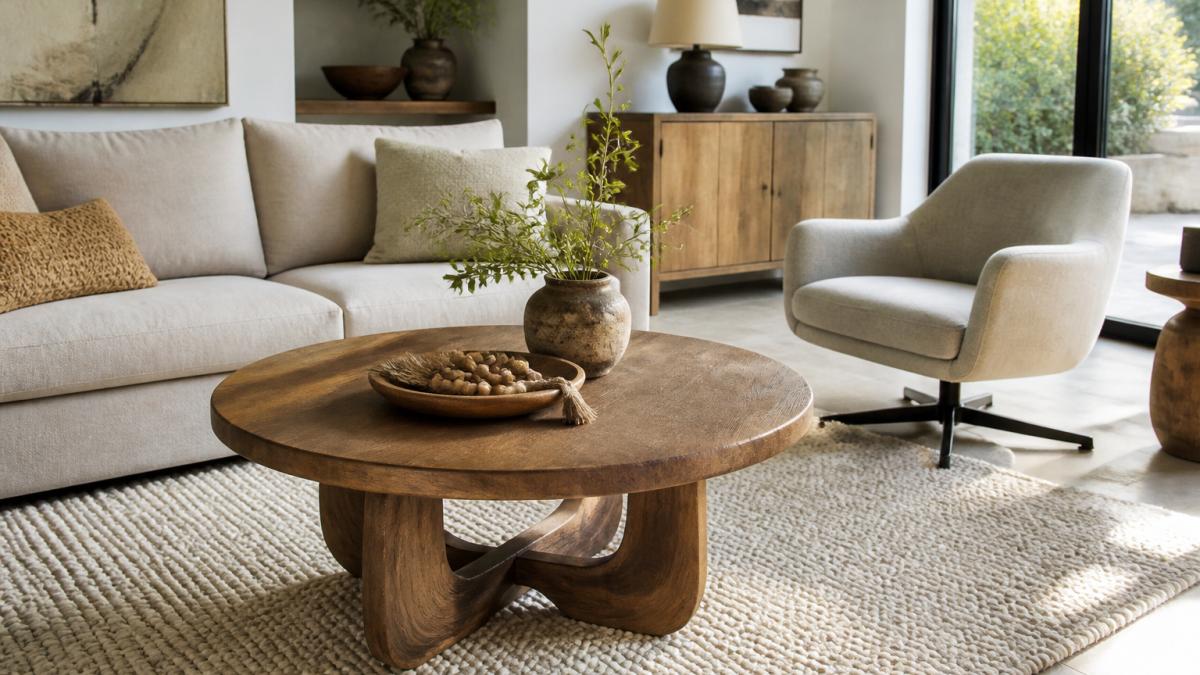
Living Room: The Rhea Teak Coffee Table and Bernie Swivel Chair
The Rhea Teak Wood 32" Round Coffee Table ($1,200) anchors a living room with a sculptural base of interlocking reclaimed teak. Every piece shows different grain, knots, and organic texture, so no two are identical.
Pair it with the Bernie Swivel Chair ($1,715), which blends clean modern lines with American craftsmanship and customizable fabrics. It works in a reading corner or as flexible seating that turns toward conversation without being dragged across the floor.
Dining Room: The Dolma Dining Table and Marzio Dining Chair
The Dolma Dining Table ($2,750) makes a dining room feel intentional: cast aluminum hexagons woven into a basket-inspired circular form, brass-plated and polished to a high sheen, topped with 72-inch clear tempered glass. Think of it as jewelry for the home.

Around it, the Marzio Dining Chair ($649) mixes eras: a traditional spindle frame in amber-finished ash with an upholstered seat and back, plus wooden armrests.
Bedroom and Office: The Raffael Desk and Catori Cabinet
The Raffael Desk ($2,699) is a two-tier desk in solid mango wood with intricate carving and a float-like feel, supported by gunmetal-finished iron legs. The material mix keeps it modern rather than heavy.
For storage, the Catori 2-Door Cabinet ($1,100) has 3-dimensional honeycomb striped doors in smoked ivory mahogany with antique bronze iron handles and one adjustable shelf. It works in a bedroom, dining room, or hallway.

Sustainable Handcrafted Furniture: Materials That Matter
Sustainability in furniture comes down to three questions: where the material came from, how long the piece will last, and whether it can be repaired instead of replaced.
Natural and responsibly sourced materials do most of the work. Reclaimed teak gives new life to wood that already served a purpose, while solid wood, wool, linen, and stone avoid the composites and veneers that fail first in mass-produced pieces.
Small-batch production also reduces waste. A maker cutting one table to order uses less material than a factory cutting hundreds to forecast.
Solid Wood Furniture for Contemporary Homes: What to Look For
Most guides tell you to look for "quality construction" and stop there, useless advice in a showroom.
1. Start underneath, not on top. Flip the chair, turn the table over, pull the drawer all the way out. The underside is where shortcuts hide. Look for:
- Corner blocks and glue blocks at the inside corners of case goods and chair frames. These triangular blocks glued and sometimes screwed into a right angle brace the joint; their absence on a heavy piece is a warning.
- Screw and staple patterns. A few screws reinforcing a joint is normal. A frame held together mainly by screws driven into end grain, or by staples, will loosen, end grain does not hold a screw well.
- Drawer bottoms. A thin, stapled plywood or hardboard bottom that flexes under hand pressure will sag under a full drawer. A solid-wood or thick plywood bottom set into a groove in the drawer sides is the durable pattern.
2. Identify the joint type by name. Joinery is the single best predictor of lifespan, and the vocabulary is small enough to learn in an afternoon:
- Mortise-and-tenon: a rectangular tongue (tenon) cut into one member fits a matching cavity (mortise) in the other. Common in table aprons, chair rails, and bed frames. Strong, and it can be glued, pinned, or wedged.
- Dovetail: interlocking fan-shaped pins and tails, most often at drawer corners. Hand-cut dovetails are irregular, machine-cut uniform; both are strong. What matters is that the joint is tight, no visible gaps, no filler.
- Butt joint with screws only: the weakest common pattern. Acceptable on a small decorative shelf; not on a dining chair or table apron.
If a seller cannot tell you what joint holds the frame together, that is itself information.
3. Read the finish, and ask whether it can be repaired. Finish is where a piece either ages gracefully or becomes a permanent problem:
- Hand-rubbed oil and wax: soaks into the wood, leaves a low-sheen, tactile surface, and can be spot-repaired with a rag and a little oil. It needs periodic re-oiling and offers less protection against water rings and stains.
- Conversion varnish and catalyzed lacquer: hard, durable, resistant to moisture and alcohol, common on commercial-grade case goods. The trade-off: a chip or scratch is hard to repair invisibly, usually the whole surface must be refinished.
- Water-based polyurethane: lower odor and VOC than solvent-based, decent durability, and easier to touch up than a catalyzed finish. Applied heavily, it can look slightly plastic on open-grain woods.
Ask the seller which category the finish falls into and whether they sell a matching touch-up product.
**4.
Rhea Teak Wood 32" Round Coffee Table →
5. Weigh the piece, or ask for the shipping weight. Solid wood is heavy.
6. Understand that solid wood moves, and look for joinery that allows it. Wood expands and contracts with humidity, mostly across a board's width, not along its length. A well-built piece accommodates that movement instead of fighting it:
- Tabletops are often attached to their aprons with figure-eight fasteners, Z-clips, or slotted screw holes so the top can slide slightly as it swells and shrinks. A top rigidly screwed down in every direction will eventually crack or cup.
- Frame-and-panel construction, a solid panel floating inside a grooved frame, lets the panel move without splitting the frame. This is why a well-made cabinet door is not one solid slab.
- Breadboard ends on a tabletop use a tongue-and-groove with elongated holes so the main boards can move while the ends stay flat.
Custom Handmade Furniture: Made-to-Order Options and Lead Times
Custom work is where artisanal furniture earns its premium, and where buyers most often get surprised. The surprise is rarely the craftsmanship; it is the timeline and the price breakdown. Understanding what drives both turns a vague "it takes a while" into a plan you can schedule around.
What "custom" actually means
"Custom" is used loosely. In practice it covers four levels of change, each with a different cost and time impact:
- Finish or fabric selection on a standard frame. The maker builds to an existing design and applies your chosen finish or upholstery. Smallest change, least added time.
- Dimensional modification. You change a length, depth, or height, a 72-inch table becomes 84 inches, or a sofa is built two inches deeper. This changes the cut list and sometimes the joinery, and usually requires a new shop drawing.
- Configuration change. You add a leaf, swap a leg style, add a shelf, or change a door from solid to glass. This is a design change, not a size change, and often requires a prototype or revised mockup.
- Bespoke from scratch. You bring a sketch or reference and the maker designs a one-off piece. Longest and most expensive path, usually with a deposit before any wood is cut.
Knowing which level you are asking for is the difference between a two-week change and a two-month project.
What drives the price
Custom furniture pricing is not arbitrary. It is the sum of a few visible inputs, and a good maker will walk you through them:
- Material. Species, grade, and board width matter. Wide, clear, quartersawn hardwood costs more than narrow, knotty, flatsawn stock. Reclaimed material can cost more than new because it must be de-nailed, dried, and milled before use.
- Labor hours. Hand-cut joinery, hand-carving, and hand-finishing take time a factory line does not. A hand-carved desk panel can represent dozens of hours of one person's work.
- Finishing. A hand-rubbed oil finish is labor-intensive but forgiving. A high-build lacquer or brass-plated metal component adds material cost and process steps.
A useful way to think about value: divide the price by expected service life. A $1,200 coffee table used daily for 30 years works out to roughly $40 a year. A $400 table replaced every five years works out to roughly $80 a year, and never looks as good in year four as the solid piece looks in year twenty.
Lead times: what to expect and why
Lead times vary by maker, material, and customization level, but the pattern is consistent:
- In-stock, standard finish: ships in days to a couple of weeks.
- Made-to-order in a standard finish or fabric: commonly several weeks to a few months, depending on the shop's queue.
- Custom dimensions or configuration: adds drafting and setup time on top of the build.
Two things reliably extend a timeline: a special-ordered fabric or finish, and a shop that is already booked. Ask where you are in the queue, not just how long the build takes.
Questions to ask before you place a custom order
- What is the deposit, and is it refundable if the timeline slips?
- What is the cancellation window, and what happens to the deposit after it closes?
- Will I receive a shop drawing or finish sample for approval before production starts?
Planning around a renovation
If you are mid-renovation, sequence orders by lead time, not by room. Order the longest-lead pieces first, typically upholstery, bespoke case goods, and anything with a special-order fabric or finish, then fill in with in-stock accents. A handwoven lumbar pillow, for example, can arrive quickly and finish a room while a custom sofa is still in the shop.
How to Evaluate Craftsmanship, Care, and Long-Term Value
Value in artisanal furniture is measured over decades, not at checkout. A $1,200 coffee table that lasts thirty years costs about $40 a year. A $400 table replaced every five years costs $80 a year and never looks as good.
Use this checklist when evaluating any handcrafted piece, in a showroom or online:
- Ask what the frame and joints are made of, not just the visible surface
- Confirm the finish type and whether it can be spot-repaired
- Check the warranty terms, especially for solid wood and leather
Care is simpler than most people expect. Dust with a dry cloth, keep pieces out of direct sun, and re-oil wood surfaces periodically. For petrified wood and stone, avoid acidic cleaners.
American Society of Interior Designers resources on furniture care
Frequently Asked Questions
What is artisanal furniture?
Artisanal furniture is made by skilled craftspeople who shape, join, and finish each piece by hand rather than on a mass-production line. That means solid wood joinery, natural materials like reclaimed teak or petrified wood, and finishes applied with care. At Hedi's Furniture, every piece is crafted from solid woods, natural fibers, and full-grain leathers, so each item carries unique grain patterns and subtle variations you won't find in factory-made furniture. The result is functional art that ages beautifully and holds its character for decades.
How do you mix handcrafted furniture with modern decor?
Start with a neutral base like a linen sofa or a simple rug, then layer in one or two artisanal statement pieces. For example, the Dolma Dining Table, with its brass-plated hexagon weave and glass top, works as a sculptural focal point in a minimalist dining room. Pair it with the Marzio Dining Chair, which has a traditional spindle frame in amber-finished ash and an upholstered seat. The contrast between clean modern lines and handcrafted texture is what makes the mix feel intentional rather than cluttered.
Is handmade furniture more durable than mass-produced furniture?
Handmade furniture typically uses solid wood and joinery techniques like mortise-and-tenon or dovetail joints, which resist loosening better than the staples and glue used in many mass-produced pieces. Solid wood also can be sanded and refinished if it gets scratched, while veneered particleboard cannot. Hedi's Furniture backs its craftsmanship with a Lifetime Warranty Guarantee, so you can invest knowing the piece is built to last for generations. The weight alone, such as the 163-pound Rhea Teak Coffee Table, signals the density and quality of materials.
How can you tell if furniture is genuinely handcrafted?
Look for subtle irregularities that signal a human hand: slight variations in grain, knots, or color from piece to piece. Check the joinery, as handcrafted pieces often show exposed tenons or hand-hammered metal details like the pewter base on the Chapman End Table. Ask about materials. If the maker specifies solid reclaimed teak or petrified wood rather than 'wood veneer,' that's a good sign. Finally, request details on the finishing process. Hand-rubbed oils and waxes feel different from sprayed lacquer and are a hallmark of artisanal work.
Is artisanal furniture sustainable?
It can be, especially when makers prioritize reclaimed or responsibly sourced materials. The Rhea Teak Coffee Table, for instance, is handcrafted from solid reclaimed teak, which diverts wood from waste streams. Natural fibers like wool and linen in the Fuji Handmade Rug are biodegradable and require less processing than synthetic alternatives. Sustainable handcrafted furniture also tends to last longer, which reduces the cycle of replacement and landfill waste. Ask your maker for specifics on where materials come from and how they're finished.
Artisanal furniture rewards buyers who plan ahead and ask better questions. If you want pieces built from solid woods, natural fibers, and full-grain leathers by makers who care about detail, Hedi's Furniture curates exactly that, backed by a Lifetime Warranty Guarantee, complimentary design guidance, free shipping on orders over $100, and free returns. Start with the sofa collection and build a home that still looks right in twenty years.