

Table of Contents
- Quick Comparison: Handcrafted vs Factory-Made Furniture Durability
- How to Identify High-Quality Furniture Construction
- Solid Wood vs Particle Board Durability
- Furniture Joinery Techniques Explained
- Quantitative Durability Testing: What the Data Shows
- The Hybrid Market: When Factory and Handcrafted Methods Combine
- Cost, Longevity, and Return on Investment
- Frequently Asked Questions
Last Updated: September 25, 2026
Quick Comparison: Handcrafted vs Factory-Made Furniture Durability
The core difference in handcrafted vs factory made furniture durability comes down to construction method, not marketing language. Handcrafted pieces typically use solid wood frames, traditional joinery, and repairable components, while factory-made furniture often relies on particle board, plywood, and mechanical fasteners that loosen over time. This guide from Hedi's Furniture breaks down exactly what separates a piece that lasts 30 years from one that sags in three.
| Factor | Handcrafted | Factory-Made |
|---|---|---|
| Frame material | Solid hardwood | Particle board, MDF, plywood |
| Joinery | Dovetail, mortise and tenon | Staples, screws, glued joints |
| Repairability | High | Low |
| Expected lifespan | 20-30+ years | 5-10 years |
| Upfront cost | Higher | Lower |
How to Identify High-Quality Furniture Construction
High-quality furniture construction shows three things: a solid wood frame, traditional joinery at stress points, and a finish that reveals rather than hides the wood grain. Flip the piece over. If you see staples, particle board, or a frame that flexes under light pressure, you're looking at short-term construction.
The Three Signs of a Well-Built Frame
- Solid wood at corners and rails. Knock on the frame. A dull thud means particle board. A sharper, denser sound means hardwood.
- Corner blocks or dowels, not just staples. Staples pull out under repeated stress. Dovetail joints and mortise and tenon joints hold.
- No flex when you lift one corner. A well-built frame stays rigid. If it twists, the joints will fail within a few years.
A common mistake is judging by weight alone. Heavy furniture can still hide MDF under a veneer. Look at the underside and the back, not the showroom face.
Solid Wood vs Particle Board Durability
Solid wood outlasts particle board by a wide margin because it can be sanded, refinished, and re-glued. Particle board, made from wood chips bonded with resin, swells when it absorbs moisture and crumbles once its fasteners strip. MDF behaves similarly, though it machines more cleanly.
How Each Core Material Ages Over 10 to 20 Years
- Solid wood: Develops patina, can be refinished multiple times, joints can be tightened.
- Plywood: Holds up better than particle board but delaminates if water penetrates the edges.
- MDF: Stable in dry rooms, but screw holes strip easily and it cannot be repaired once damaged.
- Particle board: The weakest option. Moisture causes swelling, and glued joints fail first.
Many buyers find that a solid wood piece bought once costs less over 20 years than three particle board replacements. That math matters more than the sticker price.
Furniture Joinery Techniques Explained
Furniture joinery techniques determine how long a piece survives daily use, because every joint is a load path. When you sit on a chair or lean on a table, force travels from the surface through the rails into the legs and down to the floor. A joint that spreads that force across a large glued surface area, or that mechanically locks two pieces together, will outlast one that concentrates force on a single metal fastener.
The Four Forces Every Joint Must Resist
Understanding durability means understanding what breaks joints. Four load types do most of the damage:
- Racking (side-to-side shear): The stress that makes a cheap chair wobble. It concentrates at the leg-to-apron connection.
- Racking (front-to-back): What happens when you lean back in a dining chair. It pulls the back legs away from the seat frame.
- Cyclic loading: Repeated sit-and-stand cycles. Each cycle slightly compresses the wood around a screw or staple, enlarging the hole.
- Racking under moisture cycling: Wood expands and contracts with seasonal humidity. A rigid metal fastener doesn't move with it, so the wood fibers around it crush and strip over time.
Dovetail Joints: Why They Resist Pull-Apart
Dovetails appear most often in drawers, and they work because of geometry, not glue. The interlocking wedge shapes, pins on one board, tails on the other, mean that pulling the drawer face away from the side actually forces the tails tighter into the pins. A well-cut dovetail can hold under load even with degraded glue, which is why 19th-century dovetailed drawers are still functional today.

Mortise and Tenon: The Frame Joint That Lasts Generations
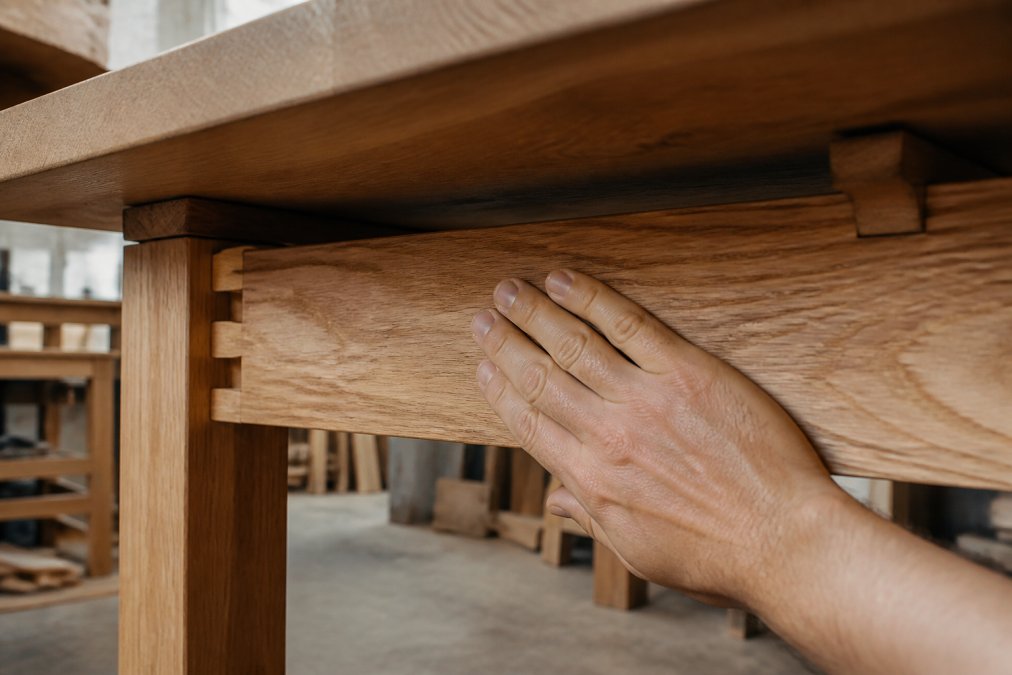
A mortise and tenon seats one piece of wood into a carved pocket in another. The tenon, the protruding tongue, is typically one-third the thickness of the rail, and the mortise is cut to match. Glue bonds the long grain of the tenon to the long grain of the mortise walls, creating a glue surface many times larger than a screw's threads can grip.
Why Staples and Screws Loosen
Staples and screws are fast to assemble and cheap to automate, but they concentrate force at a small number of points. As wood expands and contracts with the seasons, the fastener doesn't move with it. The wood fibers around the screw threads or staple legs crush, the hole enlarges, and the joint develops play. Once play starts, every subsequent load accelerates the failure.
The Hybrid Joint: Where CNC Meets Hand-Finishing
A growing category of mid-to-high-end furniture uses CNC routers to cut mortises and tenons to tight tolerances, then hand-fits and hand-finishes the joint. This hybrid approach can produce more consistent joints than pure hand-cutting at a lower cost than fully bespoke work. The catch is quality control: a CNC-cut mortise is only as good as the glue and the clamping that follow it.
How to Inspect a Joint in 60 Seconds
- Flip the piece over. Look at the underside of the seat frame or table apron.
- Find the joint. At a chair's back leg, look for a visible tenon or a corner block.
- Apply light pressure. Gently rock the piece. A well-jointed frame stays rigid; a stapled frame flexes at the corner.
- Look for squeeze-out. A thin bead of dried glue along the joint line is a good sign, it means the maker used enough adhesive and clamped it properly.
- Check for corner blocks. Solid wood corner blocks screwed and glued into a frame add rigidity, but they are a supplement to good joinery, not a substitute for it.
Quantitative Durability Testing: What the Data Shows
Formal durability testing measures a piece against repeated stress, not just appearance. The Business and Institutional Furniture Manufacturers Association standards sets voluntary performance benchmarks for seating, desks, and storage, covering cycles of load, impact, and stability. Few factory-line pieces are tested to these levels, and fewer still publish the results.
The Hybrid Market: When Factory and Handcrafted Methods Combine
A growing middle ground uses CNC machining for precision parts and hand-finishing for joints and surfaces. This "hybrid" approach can deliver better consistency than pure handcrafting at a lower price than fully bespoke work.
Cost, Longevity, and Return on Investment
The upfront cost of handcrafted furniture is higher, but the return on investment favors it over time, and the math is more concrete than most buyers expect. The key variable is not sticker price but cost per year of use, which combines purchase price, expected lifespan, and repair or replacement costs.
The Cost-Per-Year Calculation
A simple formula: divide the purchase price by the expected service life, then add any maintenance or repair costs.
- A mass-market sofa at $900 with a 7-year lifespan costs about $129 per year.
- A handcrafted sofa at $2,975 with a 25-year lifespan costs about $119 per year, and that assumes no reupholstery.
- If the handcrafted sofa is reupholstered once at year 15 for roughly 40% of its original price, the cost per year rises to about $167, still competitive with replacing the mass-market sofa three times over the same span.
What Drives the Longevity Difference
Three factors separate a piece that lasts 7 years from one that lasts 25:
- Frame construction. A solid hardwood frame with mortise-and-tenon or doweled joints can be re-glued and re-tightened. A particle board frame with staples cannot, once the fastener holes strip, the frame is scrap.
- Repairability. Handcrafted pieces are built to be disassembled. Cushions can be re-stuffed, springs can be re-tied, and frames can be re-glued. Factory pieces are often glued and stapled shut, making repair cost more than replacement.
- Resale value. Solid wood furniture from known makers holds a meaningful fraction of its original price on the secondary market. Mass-market furniture typically has near-zero resale value after a few years.
The Repair-or-Replace Decision
A common pattern is that the first repair on a mass-market piece costs 40-60% of the original purchase price, which pushes most owners toward replacement. On a handcrafted piece, the same repair, re-gluing a joint, replacing a cushion, re-tying a spring, often costs 10-20% of the original price because the piece was designed to come apart.
The Variables That Change the Math
Cost-per-year is a useful frame, but three variables can flip the conclusion:
- How long you keep it. If you move every three years and sell your furniture each time, the resale advantage of handcrafted pieces matters more than the lifespan advantage.
- How hard you use it. A guest-room chair and a daily-use family dining chair face very different load cycles. The heavier the use, the faster the cost-per-year gap widens in favor of handcrafted construction.
- Local repair labor rates. In markets with high labor costs, the repair-or-replace threshold shifts toward replacement for cheap pieces and toward repair for well-built ones.
Frequently Asked Questions
What type of furniture lasts the longest?
Solid wood furniture with traditional joinery lasts longest. Pieces built with mortise and tenon or dovetail joints, hardwood frames, and 8-way hand-tied spring systems routinely last 20 years or more with proper care. For example, the FRANNIE SOFA from Hedi's Furniture uses hardwood frames and an 8-way hand-tied spring system designed for long-term durability. Factory-made furniture using particle board and stapled joints typically lasts 5 to 10 years before structural failure.
Is manufactured wood as good as real wood for furniture durability?
No. Particle board and MDF are engineered wood products made from wood particles and resin. They are weaker under stress, cannot hold screws after repeated use, and swell when exposed to moisture. Solid wood, by contrast, has natural grain that runs the length of each board, giving it structural integrity that holds up to decades of wear. Plywood falls between the two: it is stronger than particle board but still relies on adhesives and cannot be refinished as many times as solid wood.
How can you tell if furniture is high quality before buying?
Check three things: frame material, joint type, and spring system. Look for solid wood or hardwood frames, not particle board. Dovetail joints and mortise and tenon joints signal handcrafted construction; staples and glue alone signal factory-line production. For upholstered pieces, ask whether the springs are 8-way hand-tied or sinuous wire. Also check for a lifetime warranty on the frame, which Hedi's Furniture offers on pieces like the Genoa Leather Dining Chair.
Does handcrafted furniture offer better value over time?
Yes, when you calculate cost per year of use. A $5,500 handcrafted sofa that lasts 25 years costs $220 per year. A $1,500 factory-made sofa that lasts 7 years costs $214 per year, and you replace it three times. The handcrafted piece also holds resale value, can be reupholstered, and avoids the environmental footprint of repeated manufacturing and disposal. The upfront cost is higher, but the return on investment favors handcrafted construction.
Can factory-made furniture ever match handcrafted durability?
In limited cases, yes. Some factories use CNC machining to cut mortise and tenon joints with precision that matches hand-cutting. The difference is in quality control and material selection. A factory can produce a durable piece if it uses solid wood and traditional joinery, but most mass-market factories prioritize speed and cost, choosing particle board and stapled joints instead. The hybrid market exists because some manufacturers combine factory efficiency with handcrafted methods for the structural components.
Furniture durability comes down to materials, joinery, and whether a piece can be maintained rather than discarded. Hedi's Furniture builds every piece from solid woods, natural fibers, and full-grain leathers, backed by a Lifetime Warranty Guarantee, complimentary design guidance, and free shipping on orders over $100. If you're ready to invest in furniture that ages beautifully instead of wearing out, explore the sofa collection and see the difference handcrafted construction makes.