

Table of Contents
- Why Verifying Ethically Sourced Wood Matters for Your Home
- Wood Sourcing Certifications: What FSC and PEFC Labels Actually Mean
- How to Read FSC-Certified Wood Labels and Avoid Greenwashing
- Questions to Ask Furniture Makers About Wood Sourcing
- Reclaimed Wood Furniture: A Sustainable Alternative with a Story
-
Your 7-Step Verification Checklist for Ethically Sourced Wood
- Step 1: Identify the species, and check its risk level
- Step 2: Name the origin region
- Step 3: Find the certification and read the claim type
- Step 4: Look up the certificate code
- Step 5: Confirm chain of custody covers the finished product
- Step 6: Ask about legality, and get a specific answer
- Step 7: Get it in writing
- The verification table
- What to do when a seller can't provide evidence
- Frequently Asked Questions
Last Updated: October 15, 2026
Why Verifying Ethically Sourced Wood Matters for Your Home
A beautiful grain tells you nothing about where the tree grew or who cut it. Ethically sourced wood is timber harvested and traded in ways that protect forests, respect workers and communities, and comply with local laws. At Hedi's Furniture, we work with reclaimed teak, reclaimed pine, and mango wood, so we've had to ask hard questions of every supplier.

That matters beyond your conscience: forest management shapes how dense, stable, and long-lasting the lumber becomes.
The Link Between Forest Health and Furniture Quality
Slow-grown trees from well-managed forests produce tighter grain and fewer internal stresses, so furniture is less likely to cup, crack, or warp.
When a maker can trace their wood, you get a healthier forest and a piece that lasts for decades.
Wood Sourcing Certifications: What FSC and PEFC Labels Actually Mean
Certification is the fastest shortcut to a confident answer, if you know what each label covers.
The Forest Stewardship Council's certification overview explains that FSC sets environmental, social, and economic requirements for forest management. PEFC works differently, recognizing national schemes that meet its benchmark.
Most buyers never hear this: a label on a finished sofa covers only part of the story.
Forest Management vs. Chain-of-Custody Certification
These are two separate certificates, and mixing them up is the most common mistake we see.
- Forest management certification applies to the forest itself, confirming the land is managed to a standard covering replanting, biodiversity, and worker safety.
- Chain-of-custody certification tracks material from forest to finished product, confirming the certified wood in a specific item can be traced through every handler.
A maker can hold chain-of-custody certification without owning any forest. What matters is that the paperwork connects your table back to a certified source.
How to Read FSC-Certified Wood Labels and Avoid Greenwashing
FSC-certified wood comes with one of three label types, and they are not equal.
- FSC 100%: every bit of wood fiber in the product comes from FSC-certified forests.
- FSC Mix: a blend of certified, recycled, and controlled wood. The controlled portion meets minimum requirements but isn't fully certified.
- FSC Recycled: all fiber is reclaimed or recycled material.
Greenwashing shows up in vague language. Phrases like "eco-friendly," "sustainable forest," or "responsibly harvested" mean nothing on their own, because no third party checks them.
The Federal Trade Commission's Green Guides set the rules for environmental marketing claims and warn against broad, unqualified statements that buyers can't verify.
Questions to Ask Furniture Makers About Wood Sourcing
Direct questions get direct answers, and evasive ones tell you plenty. Any maker proud of their supply chain will welcome them.
Start with these:
- Which wood species is this piece made from, and where does that species grow?
- Do you hold chain-of-custody certification, and under which program?
- Can you share the certificate code or a copy of the documentation?
- Is the certification on the wood only, or on the whole product?
- How do you confirm your suppliers follow local forestry and labor law?
- What happens to the piece if a claim turns out to be false?
That last question separates serious makers from talkers: a real answer involves documentation, not reassurance.
For species-specific risk, the U.S. Fish & Wildlife Service timber import guidance is worth checking, since some woods carry legal restrictions on trade.
Reclaimed Wood Furniture: A Sustainable Alternative with a Story
Reclaimed wood sidesteps the logging question entirely, because the tree was cut long ago.
Decades of air-drying also leave reclaimed wood unusually stable, so it moves less than fresh-cut lumber, and carries a patina new wood can't copy.
Our Mariz Tall Bookcase is built from authentic reclaimed teak, and each piece shows its own grain and history. You can see it here: Mariz Tall Bookcase.
Reclaimed isn't automatically ethical
A story is not a certificate. Reclaimed wood can still be problematic if the material was removed illegally, salvaged from a protected structure, or sourced from a demolition site where workers weren't treated fairly. Ask three questions:
- Where did the material come from? A named building, mill, or salvage yard is a real answer. "Old wood" is not.
- Was the removal legal? Salvage from a permitted demolition is different from timber pulled out of a protected forest and relabeled as reclaimed.
- Who did the work? Salvage and demolition labor is often informal. Ask whether the supplier can describe the working conditions.
The social side of ethical sourcing
Environmental certification gets most of the attention, but ethical sourcing also covers the people who harvest, mill, and finish the wood.
For buyers, the practical questions are:
- Workers: Can the maker describe who harvested and milled the wood, and under what conditions? Certification standards address worker safety and fair treatment, but a maker who can't say anything about their supply chain is relying on the certificate alone.
- Local communities: In many timber-producing regions, forests are community-managed or sit on customary land. Certification schemes require consultation with affected communities, but the quality of that consultation varies.
- Indigenous rights: Free, prior, and informed consent (FPIC) is the standard many certification schemes and international frameworks use for projects affecting Indigenous land. Ask whether the maker's suppliers operate under FPIC where it applies. A maker who has never heard the term is unlikely to be verifying it.
Most buying guides stop at the label. But a label on a finished sofa usually covers only the wood, not the finish, glue, or fabric, and says nothing about the workers who touched the piece along the way.
How to ask about social responsibility without an interrogation
You don't need a supplier audit to get a useful answer. Two or three questions usually reveal whether a maker has thought about this at all:
- "Can you tell me who harvested this wood and where?"
- "Does your certification cover worker conditions, or only the forest?"
- "How do you handle land rights or community consultation in the regions you source from?"
A maker who can answer these, even imperfectly, is doing more than most. A maker who can't may still sell good wood, but treat the ethical claim as unverified.
Our Simone 94" Dining Table uses FSC Certified Reclaimed Wood with thick reclaimed pine legs, hand brushed and polished with organic water-based materials. The Rio Media Console takes a different path, pairing white-washed mango wood with iron legs. Both show how a documented material choice shapes the finished piece, and both come with the documentation to back the claim.

Your 7-Step Verification Checklist for Ethically Sourced Wood
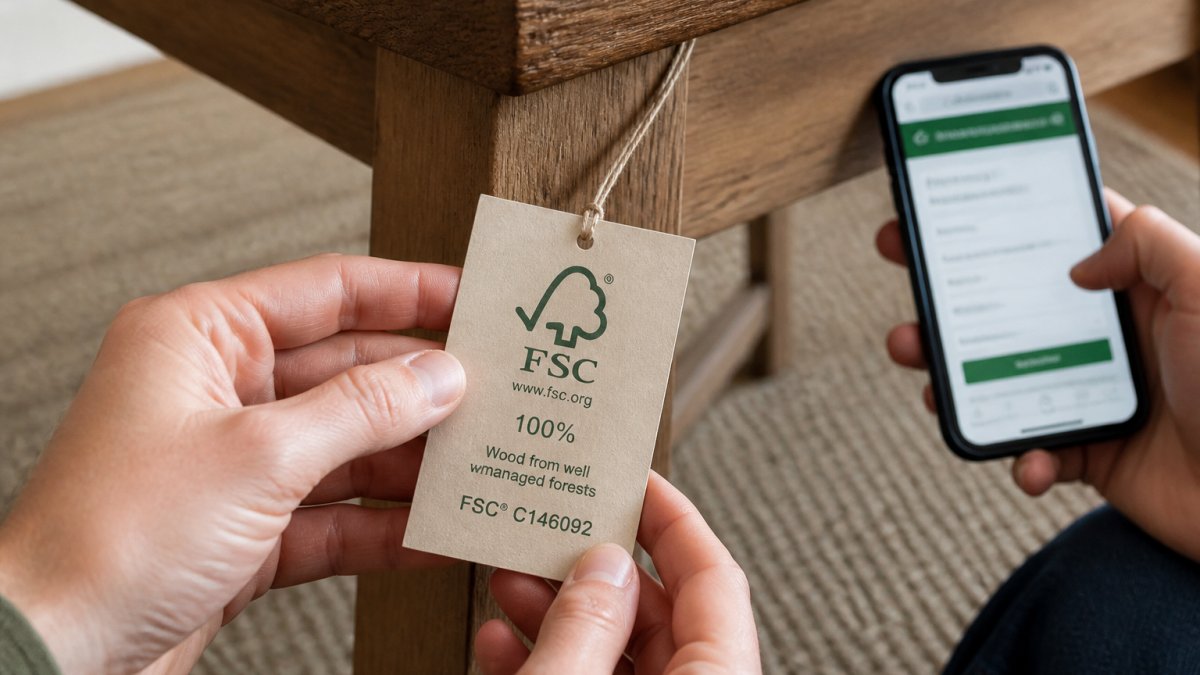
Most guides stop at "look for the FSC logo." That advice fails the moment a seller prints a lookalike mark or applies a valid certificate to the wrong product.
Step 1: Identify the species, and check its risk level
Ask for the exact species, not "solid wood" or "hardwood." Legality and conservation risk vary enormously: tropical hardwoods such as mahogany, rosewood, and ebony carry tighter trade restrictions than temperate species like oak, maple, or pine.
What a real answer looks like: a specific common and botanical name (for example, "teak, Tectona grandis" or "black walnut, Juglans nigra")
Where to check: the U.S. Fish & Wildlife Service timber import guidance and the Convention on International Trade in Endangered Species (CITES) appendices list species with trade restrictions.
Step 2: Name the origin region
"Imported" is not an origin. A country or region should be stated, ideally a state, province, or forest concession, because origin determines which laws applied at harvest and which certification scheme is plausible.
What a real answer looks like: "FSC-certified teak from a plantation in Indonesia" or "reclaimed longleaf pine from a demolished mill in Georgia."
Red flag: origin that changes between the product page, the spec sheet, and the invoice.
Step 3: Find the certification and read the claim type
Look for FSC or PEFC by name, then read which claim applies. FSC uses three product labels, 100%, Mix, and Recycled, and they mean different things. PEFC endorses national schemes, so the label may carry a scheme name rather than the PEFC acronym alone.
What a real answer looks like: a named program, a claim type, and a certificate holder (the company the certificate was issued to).
Step 4: Look up the certificate code
This is the step almost nobody does, and it catches the most problems. Both FSC and PEFC publish searchable public databases.
What a real answer looks like: a code that returns a live record for the company you're buying from.
What to do when it fails: if the code returns nothing, belongs to a different company, or covers the wrong product category, ask the seller to explain in writing.
Step 5: Confirm chain of custody covers the finished product
A forest-management certificate proves a forest is well managed. A chain-of-custody certificate proves material can be traced from that forest through every handler to the finished item.
What a real answer looks like: a chain-of-custody certificate whose scope includes the finished furniture, plus the ability to name the supplier tier where the certified material entered the chain.
Red flag: certification that covers only raw lumber while the finished piece is sold as "certified."
Step 6: Ask about legality, and get a specific answer
Legality is not the same as certification. A product can be certified and still raise questions if the species is restricted or the origin is unclear.
What a real answer looks like: a named due-diligence process, for example, requesting harvest permits, export documentation, or a supplier declaration, not a general assurance that "all our wood is legal."
Step 7: Get it in writing
Verbal promises evaporate. Ask for the species, origin, certification program, claim type, and certificate code in a spec sheet, invoice note, or email. It protects you if a claim proves false and forces the seller to commit to specifics.
What a real answer looks like: a written record you can keep and compare against the certificate database.
The verification table
| Step | What You're Checking | What a Real Answer Looks Like | Red Flag |
|---|---|---|---|
| Species | Exact wood type, common and botanical name | "Teak, Tectona grandis" | "Solid wood" only |
| Origin | Country or region stated | Named region or concession | "Imported" with no detail |
| Certification | FSC or PEFC named, claim type stated | Program + claim + certificate holder | Logo with no code |
| Code lookup | Certificate is valid and matches seller | Live record for the company | Code not found or wrong category |
| Chain of custody | Covers the finished piece | Scope includes finished furniture | Covers raw wood only |
| Legality | Species rules reviewed | Named due-diligence process | No answer given |
| Documentation | Written confirmation | Spec sheet, invoice note, or email | Verbal promise only |
What to do when a seller can't provide evidence
This is the most common outcome, and it's not always bad faith: small makers may buy through distributors who don't pass documentation down the chain. The question is how the seller responds.
- If they say "I'll find out and get back to you", that's a reasonable answer. Give them a chance to produce the code or documentation.
- If they deflect, change the subject, or offer a discount instead of a document, treat the claim as unproven and price the piece accordingly, or buy elsewhere.
- If they claim certification but can't name the program or the certificate holder, assume the claim is marketing, not fact.
A maker who can't verify a claim today may still be worth buying from, but buy on the basis of the wood you can see, not the ethics you can't confirm.
Frequently Asked Questions
How can you tell if wood is ethically sourced?
Look for third-party certifications like FSC or PEFC on the product label. Ask the retailer for chain-of-custody documentation that traces the wood from forest to finished piece. For reclaimed wood furniture, request details on the wood's origin and how it was processed. A transparent supplier will provide specific answers about species, region, and harvesting practices rather than vague sustainability claims.
What does it mean if wood is FSC certified?
FSC certification means an independent auditor verified that the wood comes from a forest managed to protect water quality, wildlife habitat, and Indigenous rights. There are three FSC label types: 100% (all certified content), Mix (certified and recycled content), and Recycled. Each label carries a unique code you can verify on the FSC database. FSC-certified wood is one of the strongest indicators of responsible sourcing.
What questions should I ask a furniture maker about wood sourcing?
Ask these four questions: What wood species is this piece made from, and where was it harvested? Can you provide chain-of-custody documentation? Is the wood FSC or PEFC certified? How do you verify your suppliers' labor practices? A maker who prioritizes ethical sourcing will answer these directly and provide documentation, not just assurances.
Is reclaimed wood always ethically sourced?
Not automatically. Reclaimed wood furniture is often a strong sustainable choice because it diverts material from landfills and reduces demand for newly harvested timber. However, you should still verify the wood's original source and confirm it was reclaimed legally. Ask the maker where the reclaimed wood came from.