

Table of Contents
- Start With the End Grain: The Most Reliable Test
- Weight, Density, and the Feel of Real Wood
- Grain Patterns and Natural Imperfections to Look For
- Solid Wood vs Veneer Furniture: What the Edges Reveal
- How to Tell If Furniture Is Particle Board: The Underside and Interior Check
- Joinery, Hardware, and the Scratch Test
- Is Solid Wood Furniture Worth It? Maintenance and Longevity
- Buying Solid Wood Furniture Online: What to Check Before You Click
- Frequently Asked Questions
Last Updated: September 20, 2026
Start With the End Grain: The Most Reliable Test
Learning how to identify solid wood furniture starts with one spot most shoppers never check: the end grain. This guide walks through the tests we use when we inspect pieces ourselves.
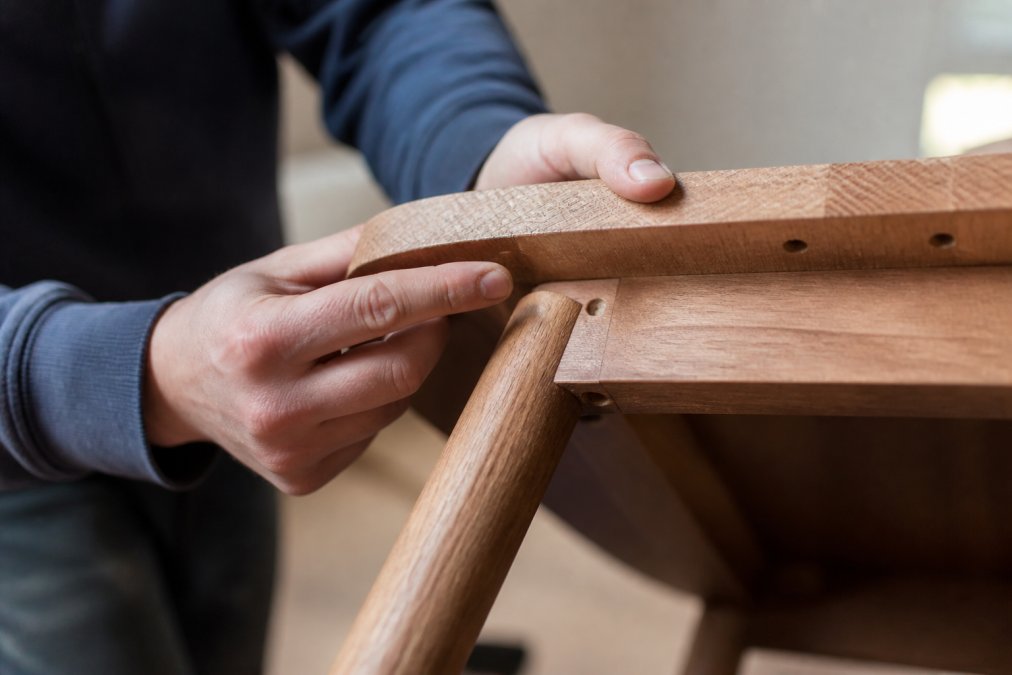
End grain is the cross-section of a board, where you see the tree's growth rings and pores. On solid wood, it looks like a tiny wood fingerprint.
- Solid wood: visible rings, pores, and slight color shifts
- Veneer: a thin top layer, often with a matching pattern glued on
- Particle board: coarse chips pressed together, no rings at all
Weight, Density, and the Feel of Real Wood
Solid wood feels heavier than it looks. A solid oak or mango piece has real heft, and you notice it the moment you lift one end. Manufactured wood, by contrast, often feels lighter than its size suggests.

Try this in the showroom:
- Lift one corner of the table or sofa frame
- Compare it to a similar-size piece nearby
- Tap the surface with your knuckle and listen
Grain Patterns and Natural Imperfections to Look For
Real wood has flaws, and that is how you know it is real. Look for knots, slight color variation, and grain that shifts as it moves across the surface. Those "imperfections" are the signature of a living tree.
- Check the top, sides, and front of a drawer
- Follow the grain from one face to the next
- Look for matching patterns that repeat
Solid Wood vs Veneer Furniture: What the Edges Reveal
The edge tells you more than the surface ever will. On solid wood, the grain runs right through the edge, and the pattern continues from the top face onto the side. On veneer, the edge shows a thin top layer over a different core material.
Here is a quick comparison to keep in mind:
| Feature | Solid Wood | Veneer | Particle Board |
|---|---|---|---|
| Edge appearance | Grain continues through | Thin top layer, visible seam | Coarse chips, no grain |
| Weight | Heavy | Medium | Light |
| Grain pattern | Unique, never repeats | Can repeat | None or printed |
| Repair potential | Can be sanded and refinished | Limited | Almost none |
| Longevity | Decades with care | Years | Short lifespan |
How to Tell If Furniture Is Particle Board: The Underside and Interior Check
Here is how to tell them apart on sight:
-
Particle board (chipboard): Coarse wood chips and sawdust pressed with resin. The texture is lumpy and irregular, like oatmeal glued into a sheet. Edges crumble when you press a screwdriver into them. It is the cheapest core and the least repairable.
-
MDF (medium-density fiberboard): Fine wood fibers pressed into a smooth, uniform sheet with no visible grain or chips. It cuts and routes cleanly, which is why it shows up in painted and lacquered furniture. It is denser and heavier than particle board, but it swells permanently if water reaches an unsealed edge.
-
HDF (high-density fiberboard): The same idea as MDF, pressed under more heat and pressure into a denser, harder panel. You will often find it as a thin back panel or drawer bottom rather than a full carcass. It resists dents better than MDF but is still not solid wood.
-
Plywood: Thin layers of real wood veneer stacked at alternating 90-degree angles and glued, like a sandwich. You can see the stacked plies on any exposed edge. Good plywood is dimensionally stable and takes screws well, it is the strongest of the engineered cores and the one most often mistaken for solid wood.
-
Open every drawer and look at the sides and bottom
-
Check the back panel and any interior shelf
-
Look at screw holes: particle board crumbles, MDF holds a screw but strips if re-driven, plywood holds, solid wood holds and can be re-glued
Joinery, Hardware, and the Scratch Test
Good joinery is a sign of quality construction. Dovetail joints interlock like puzzle pieces and hold up for decades. Screws and staples are faster and cheaper, and they loosen over time.
- Solid wood: the scratch reveals the same color underneath
- Veneer: you may see a different color or a thin layer lift
- Laminate: the scratch shows a white or synthetic core
Is Solid Wood Furniture Worth It? Maintenance and Longevity
Is solid wood furniture worth it? For most buyers, yes, if you plan to keep the piece for years. Solid wood can be sanded, refinished, and repaired. Veneer and particle board usually cannot.
The trade-offs are real, though:
- Solid wood costs more upfront
- It can expand and contract with moisture changes
- It is heavier to move
Buying Solid Wood Furniture Online: What to Check Before You Click
-
Edge and corner shots. A seller confident in solid wood will photograph the edge of a tabletop or the corner of a drawer. If every photo is a straight-on hero shot of the finished top, ask for more.
-
Underside and interior images. Request a photo of the bottom of the seat, the inside of a drawer, and the back panel. These are the spots that reveal the core material.
-
Joinery close-ups. A dovetail drawer corner or a mortise-and-tenon frame joint is hard to fake and easy to photograph. If the listing shows only the outside of a closed drawer, that is a signal.
-
Zoom on the grain. Look for a repeating swirl or knot appearing twice on one panel, that is a printed or glued pattern, not natural grain.
-
"Solid wood" means solid wood. If it is qualified, "solid wood frame," "solid wood legs", only that part is solid.
-
"Solid wood and engineered wood" usually means the visible surfaces are solid and the structural panels are not, or the reverse.
-
"Wood veneer," "engineered wood," "wood composite," and "manufactured wood" all mean the piece is not solid wood throughout.
-
A named species, mango, oak, acacia, walnut, rubberwood, is a good sign. "Wood" with no species is not.
A few more checks before you commit:
- Ask the seller directly: "Is any part of this piece veneer, plywood, MDF, or particle board?" A written answer is worth more than a listing photo.
- Look for a stated weight and compare it to a similar-size piece you know. A solid oak dining table is genuinely heavy; a listing that ships in one small box is not.
- Check the return policy and whether return shipping is on you. On a heavy piece, return freight can cost more than the furniture.
- Search the brand or seller name alongside the word "veneer" or "particle board" to surface reviews that mention the real construction.
A seller who is proud of their materials will show them. If the listing avoids the word "solid," dodges questions about the core, or shows only finished surfaces, treat that as your answer.

Frequently Asked Questions
How can I tell if wood furniture is solid wood or just a veneer?
Look at the end grain on an unfinished edge, like the bottom of a tabletop or the inside of a leg. Solid wood shows continuous grain running through the full thickness. Veneer has a thin top layer with a different material underneath, often particle board or MDF. You can also check weight: solid wood furniture feels noticeably heavier than veneered pieces of the same size.
Does solid wood furniture have a specific weight that makes it easy to identify?
Yes, weight is one of the quickest indicators. Solid wood is dense, so a solid oak dining table will feel substantially heavier than a veneered or particle board table of similar dimensions. If you can lift one end easily, it is likely composite. For online purchases, check the product specifications for wood species and weight, and read customer reviews for comments on sturdiness.
What are the visual signs of solid wood furniture versus particle board?
Solid wood shows natural grain patterns that continue across edges and corners. You may see knots, mineral streaks, or slight color variations. Particle board has a uniform, speckled texture on exposed edges and often uses edge banding to hide the core. Look underneath: particle board looks like compressed sawdust, while solid wood shows real grain. Also check for screw holes, particle board crumbles while solid wood holds threads.
Is solid wood furniture worth the higher price compared to veneer or particle board?
Solid wood furniture typically lasts for decades and can be refinished if scratched or dented, while veneer and particle board often cannot. For a piece you use daily, like a dining table or sofa frame, the durability and repairability usually justify the cost. Solid wood also develops a patina over time. If the piece is for a low-use area or temporary setup, a veneer option may be sufficient.
Knowing how to identify solid wood furniture gives you real leverage, whether you are thrifting, browsing online, or investing in a centerpiece for your home. Hedi's Furniture handcrafts sofas, tables, and decor from solid woods, natural fibers, and full-grain leathers, with complimentary design guidance and a Lifetime Warranty Guarantee on every piece. Shop the sofa collection and bring home furniture built to last for generations.